Before getting to the main story, a brief announcement:
Finding Our Way Live! with John Gleason, April 3
There's much to learn from adjacent fields, which is why the Finding Our Way episode with John Gleason (59, from June of 2025) proved so insightful. John is the organizer of notorious "THE FUTURE OF... DESIGN" conference, which last year courted controversy with the theme "Is Design Dead?"
It returns May 12-13 with the theme "Are You Ready to Lead?" Jesse and I are honored to participate, and in the run-up to the show, realized this was an opportunity to try something new—a live episode, with audience involvement.
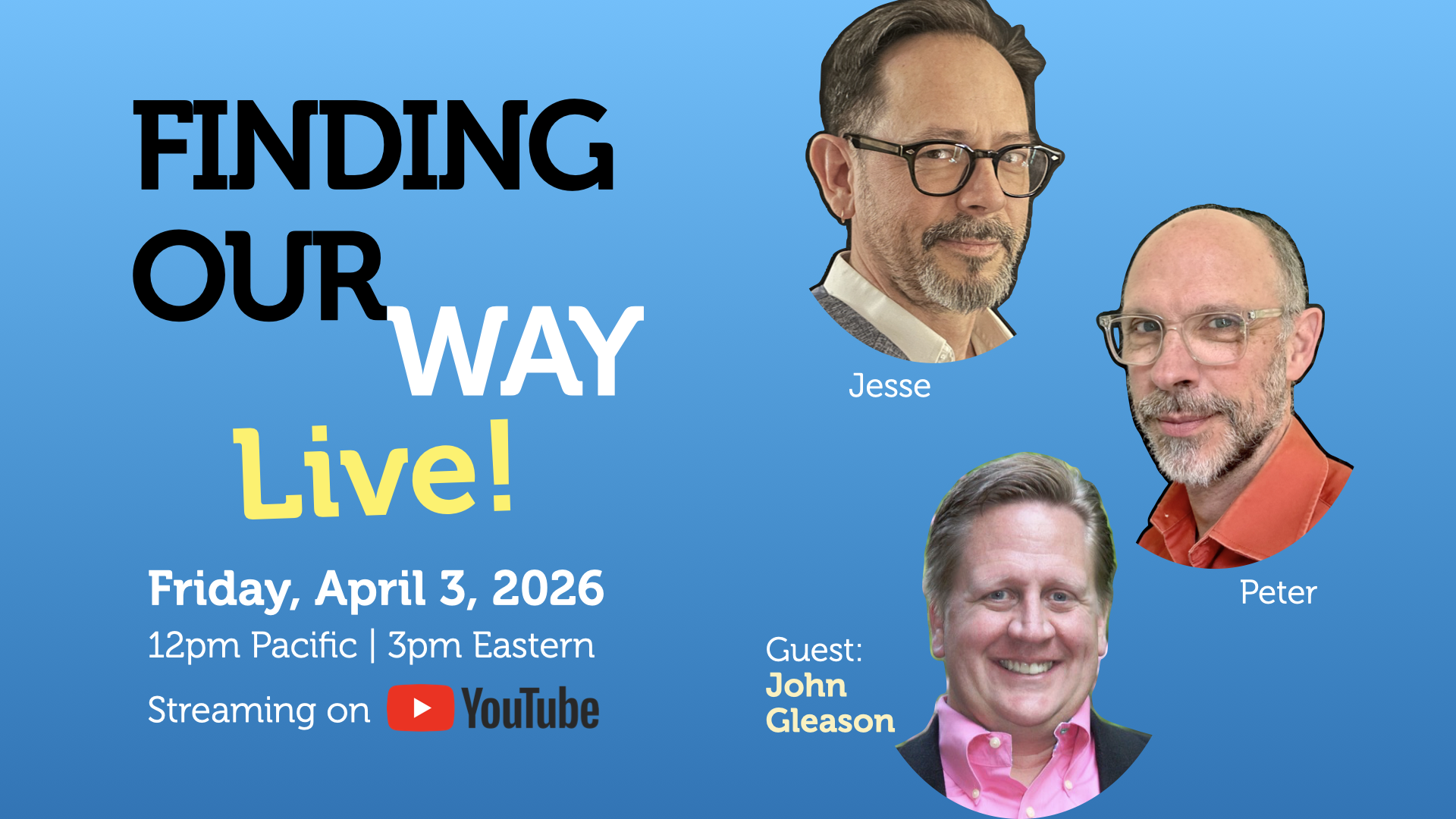
On April 3 at 12pm PT/3pm ET, join us for Finding Our Way Live! John, Jesse, and I will discuss the current state of big "D" design leadership—UX, product, brand, marketing, industrial, and more. This takes place on YouTube (though the event page is on LinkedIn), and we'll monitor chat to solicit your contributions!
AI Transformation Tests Your Team Leadership Mettle
Continuing last newsletter's theme of focus on the fundamentals, I'm realizing how AI Transformation serves as an object lesson in the core concepts of team leadership. If you're struggling, it's likely due to matters that predate any issues with new technologies.
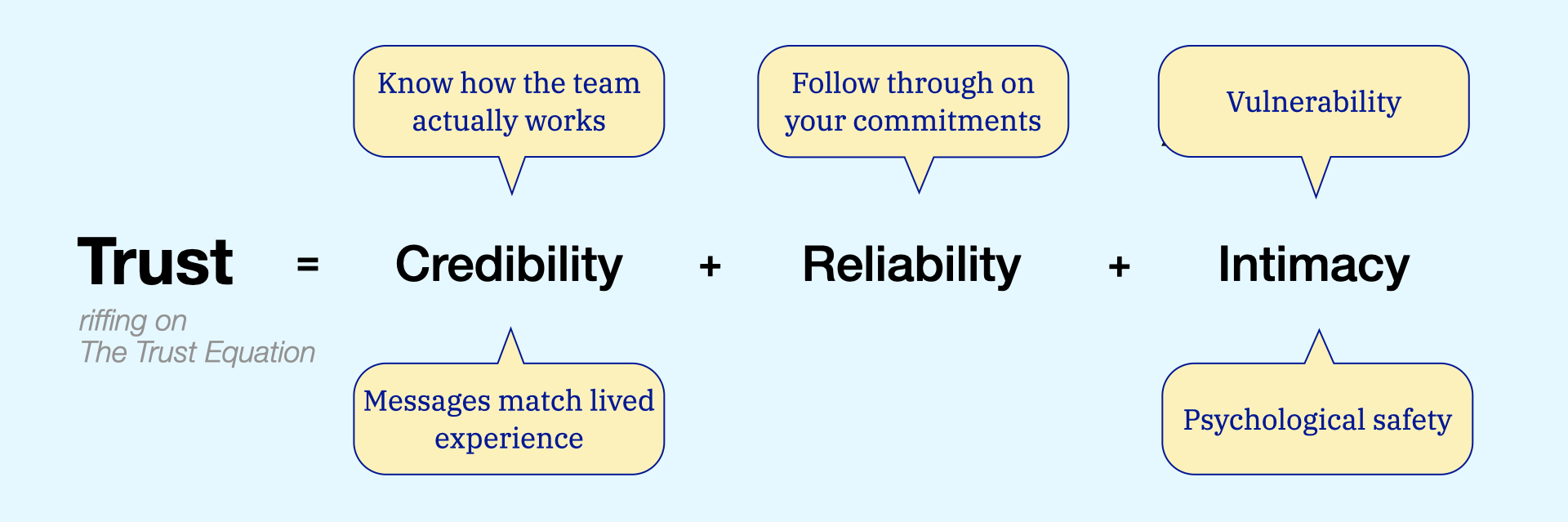
In my leadership development practice, I build on The Trust Equation, tailoring it to UX/Design teams (the word balloons):
How might this apply to the current moment?
Know how the team actually works. Perhaps the biggest change teams are seeing is in how work gets done. Deep understanding of process, practices, tools, informal workarounds, and standards is necessary for these changes to enable improvements. Without it, it's an imposition, confusing, arbitrary, and inhibiting.
Messages match lived experience. Leaders know the importance of maintaining positivity to keep their team's spirits up. But go too far, and that presents as delusion. In the years of layoffs and restructuring before this AI moment, I witnessed leaders exhibit an "Everything's fine!" kind of toxic positivity, while their teams disengaged as it appeared the leaders didn't appreciate the reality on the ground.
Now we're seeing new versions. For example, leaders insisting everything is going to be okay, nothing is changing, while their teams are anxious about job security, skill relevance, and being measured against robots. Acknowledging this tension isn't giving into negativity, it's demonstrating honesty. And it provides an opportunity for optimism: real productivity gains; the ability to directly address design debt; being freed to "move left" and tackle more strategic challenges.
Follow through on your commitments. Design leaders primarily make two commitments to their teams: their professional development, and keeping them on work worth doing.
This moment requires a heightened sensitivity to your team's development. AI tooling is threatening what many perceived to be their core skills. Providing space for people to focus on their learning (whether on AI tools themselves, or adjacent skills) and practice becomes imperative.
There's talk about how "discernment" is an increasingly important skill for designers, making sure the tools are rising above mediocrity. Given how all this acceleration brings with it more stuff to do, for design leaders, "discernment" means filtering out work that isn't worth doing, so that team members are tasked on projects with true potential.
Vulnerability. Borrowing from Brené Brown's playbook, the leaders navigating this moment best are explicit about how they don't have all their answers. They name their own uncertainty, show what they're trying, admit when something doesn't work. It's crucial for leaders to model uncertainty, so that their team members feel safer being honest about their own. When leaders perform confidence they don't have, their teams hold back their own challenges, and you don't really know what's going on with them.
Psychological safety. Tools emerge and change faster than any one person can track, new applications are invented daily, and professional norms haven't caught up. In a chaotic environment, people need to be able to experiment, fail, admit confusion, ask questions, and even push back on leadership direction without fear.
Particularly at this moment, performance needs to be about learning more than it is about output. If someone's efforts haven't resulted in delivery gains, but they and the team are wiser, that's a win.
Motivation: Autonomy, Mastery, Purpose
Creating a trusting environment is one lever a leader has to encourage greater engagement. Another is tapping into team members' motivations, and for this I draw from Daniel Pink's Drive.
Autonomy. I believe that a significant driver of people's resistance to these technologies isn't technophobia, but loss of control. People crave agency over how they work. Without it, they go through the motions. In many contexts, AI has been foisted on them by executive fiat. Instead of imposing AI tooling on them, demonstrate its benefits, make tools available, and encourage them to figure out their best ways forward. Encouraging ownership will drive greater gains.
Mastery. People give their most when operating at their level of competency. AI threatens this on two fronts: certain skills now appear obsolete, and people with extensive experience may feel like beginners again, in public.
Addressing this requires a mix of what we discussed earlier: acknowledging the potential for humility; supporting the acquisition of new mastery; optimism about the potential for greater impact; recognition of your own pivoting, and a safe space for the team to learn together. Throughout, the goal is to return people to a sense of skills building. Developing new mastery will create powerful confidence.
Purpose. The arbitrary nature of how many teams are expected to embrace AI disconnects the work from meaning. People are told to use AI for the sake of using AI, maybe to go faster and ship more.
For teams to embrace these new approaches, it has to connect to what they care about. Things like the ability to clear out a multi-year backlog of design debt that engineering could never get around to addressing, or freedom to focus on broader, organization-wide matters now that the tools can sweat the details.
For me, AI isn't all that interesting in and of itself. What intrigues me is how it exposes the strengths and weaknesses of basic organizational practices. The leaders who best navigate this moment won't be those with the best "AI strategy" (whatever that is). They'll be the ones who either already had the foundations, or seize this opportunity to put them in place.
Elevate Your Leadership Practice
This newsletter's topic will be addressed in greater detail on Week 4 of the Intentional Design Leadership Circle ("Setting Your Team Up for Success").

Starting April 15, Jesse and I host this 6-week cohort for director-and-above leaders who seek coaching and connection, but haven't had the time or budget. By creating a space to go deep across the arc of leadership practice, our intent is to help you shift from surviving to thriving. Seats are limited, and about half have already been claimed. Learn more and sign up now!