![[TMA] Design Quality Won't Manage Itself](/content/images/size/w30/format/avif/2026/03/LinkedIn-FOW2.001-2.png)
Before the main essay, a quick word from our sponsor... Um, me:
The Intentional Design Leadership Circle
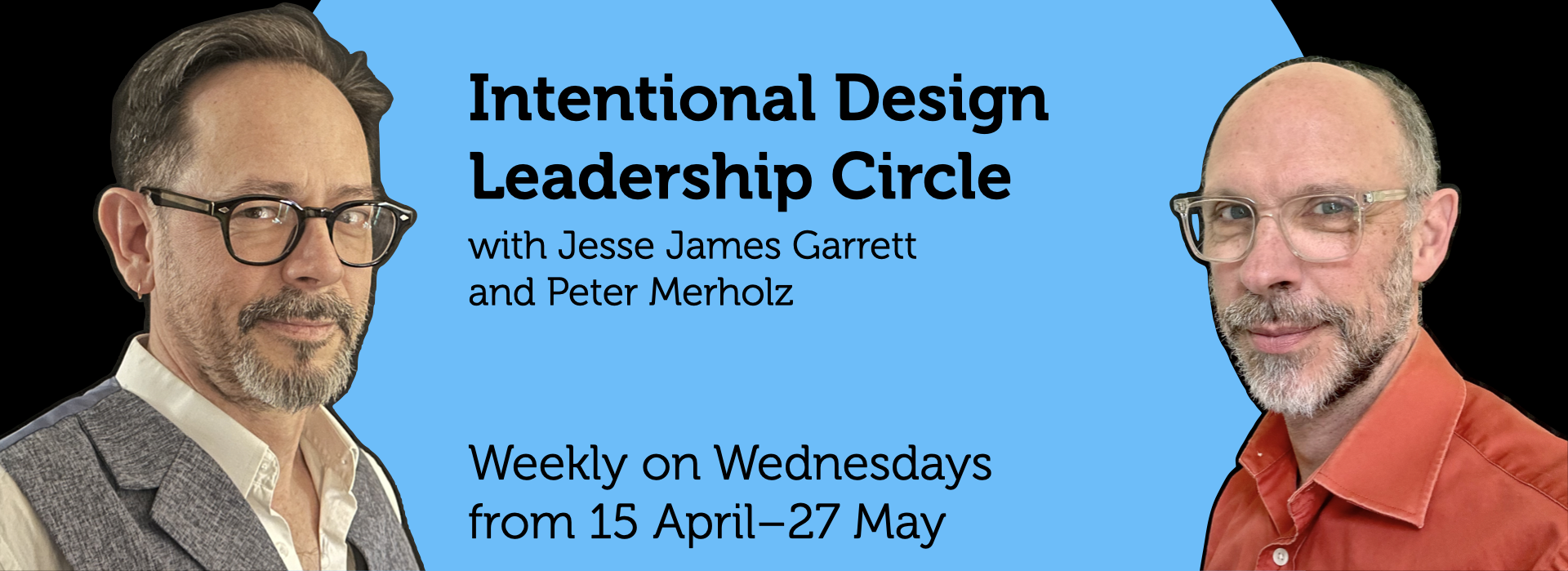
For six Wednesdays across April and May, Jesse James Garrett and I are leading the Intentional Design Leadership Circle, a weekly 90-minute cohort for Director-and-above leaders looking to step back, gain perspective, and lead from a place of clarity and purpose — rather than exhaustion and reaction.
To ensure depth, engagement, and good conversations we're limiting the number of seats to 20.
Now on to the show...
Quality is Existential to Design
Figma's 2025 research on AI and design found that while teams that used AI went faster, what they produced wasn't any better. They were just making more of the same kinds of stuff.
This didn't surprise me, because I know that most design orgs lack explicit standards by which their work is upheld, so there's no basis for improvement.
In the latest episode of Finding Our Way [Apple, Spotify, website with complete transcript], Jesse and I engaged in a wide-ranging discussion with Dan Saffer about design and AI, where Dan shared his definition of quality:
It's better than it needs to be.
And while I like the poetry of that statement (and prefer it to the more common, "you know it when you see it"), it wouldn't hold up as a standard in most companies.
Other functions have it easier. Software engineers draw from industry-wide quality criteria including reliability, performance, maintainability, and security. Product management typically focuses on standard business-y metrics such as adoption, retention, satisfaction.
So if design can't explain why something is or isn't good in terms that connect to shared organizational values and value, it will consistently lose those arguments to teams that can specifically articulate their concerns.
This is dangerous, because even if designers object to what is pushed to production, all that a design org has to show for itself is the quality of the work it ships. Lacking shared standards, the design org will be associated with mediocrity, regardless of whether they wanted to hold out for something 'better.'
This has been true since long before AI—over 5 years ago I wrote an extensive piece on the components of a quality framework—but the velocity of AI development intensifies matters.
Managing Design Quality
In addition to the challenges of defining quality, my discussions with design executive clients reveal uncertainty as to who is responsible for what aspects of directing and managing quality. This gap inevitably leads VPs and Directors to get too 'in the weeds,' disempowering their managers and leads.
To address this, I found myself repeating the same whiteboard sketch for a few different clients, so have tightened it up into what I now call the Design Quality Management Cascade, a simple framework for locating specific responsibilities at the appropriate level.
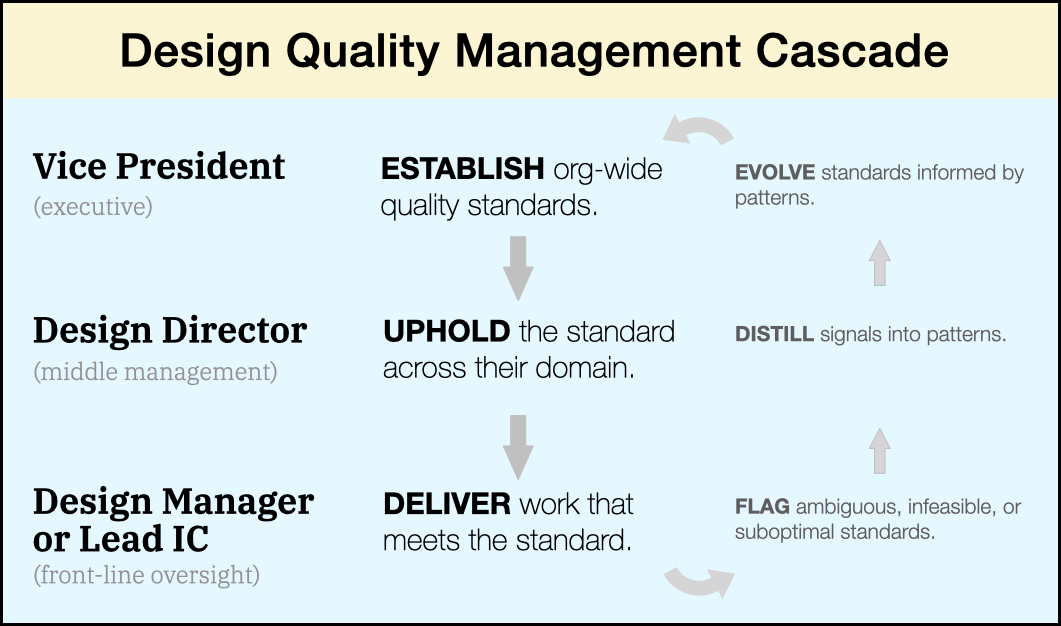
The responsibility of the VP (or whomever is lead executive) is to ESTABLISH org-wide quality standards.
This person doesn't do all the work of definition and codifying—these standards will be developed by the whole org. But they are responsible for these standards existing, where the bar is set, their robustness, and their appropriateness for the company. A VP may delegate this to an architect-level Super IC.
Design Directors (aka middle management) then UPHOLD these standards across their respective domains. This may involve translating them for their specific context—e.g., Internal tools have different demands than consumer-facing apps.
Directors coach Managers on measuring up to quality expectations, and are responsible for resolving cross-functional process issues that are preventing the quality standards to be realized.
The Design Manager or Lead IC guides practitioners to DELIVER work that meets the standard. For them, standards aren't just abstract principles or components in a design system. They're the specific attributes that their teams' work must live up to.
Where such organizational clarity is lacking, I see VPs behave like front-line managers, directing the work of ICs. This: a) signals that they don't trust their reports to handle such matters, and b) takes time away from those things only VPs are situated to do. These VPs then either cannot fulfill their mandate, or have to pull 60-hour weeks to get everything done.
Setting up the cascade will take time—coaching up your reports to live up to those expectations—but once done, distinctly spreading responsibilities across these organizational levels should free up time and effort, and lower internal tensions borne of overlapping responsibilities or unclear expectations.
It goes both ways
While the primary flow is downward through the org chart, it's crucial that critical feedback rises as needed. When putting standards into practice, Managers FLAG those that fall short—ambiguous, neglectful of context, unfeasible.
These shortcomings are communicated up to Directors, who either guide the Managers in how to apply the standards, or DISTILL these signals into patterns worth addressing broadly.
Those patterns are then shared with the VP (or design architect) as an input to EVOLVE the standards. Quality is not static. All kinds of circumstances may change: technology, platforms, audiences, strategy.
Chaos is a ladder—climb it!
We're starting to see how AI accelerates output. Without improvements in judgment, we'll just see more mediocrity faster.
By treating quality as key to their infrastructure, and setting it up so that it can be handled distinctly and effectively, in this AI Moment of Discombobulation, design organizations can position themselves not just as contributors, but leaders of product development work.
Masterclass: Elevating Your Design Team
There's a second cohort I'm involved with.
For those who seek a more hands-on, in-depth, activities-based training experience, I am once again teaching Elevating Your Design Team, a 7-week masterclass focused on standing up an effective and empowered design organization, featuring these topics:
- Define Your Design Team (organizational health, team charters)
- Plan Your Organizational Structure (capabilities, team shape)
- Build a Flexible Career Architecture (skills, practices, levels, roles)
- Recruit and Hire Effectively (role profiles, job descriptions, interview processes)
- Clarify the Value of Design (metrics, business cases)
Each session features me with guest experts, activities that make the concepts stick, practical tools that you can apply to your job, and peers tackling similar challenges. Learn more and register.