![[TMA] Product Management's Failure is UX/Design's Opportunity](/content/images/size/w30/format/avif/2026/01/ChatGPT-Image-Jan-6--2026--09_29_38-AM.png)
[At the end of this post I promote my forthcoming UX/Design Leadership Demystified masterclass (Jan 20-21, 2026).]
I'm kicking off 2026 with something often discussed in small groups among design leaders and which I think warrants a broader conversation.
Much of the public discussion of product management and product development over-indexes on savvy Silicon Valley companies, while most of this kind of work happens in legacy enterprises (financial and insurance services, retail, travel and hospitality, health care, etc.) or B2B software companies that underwent some kind of 'transformation' in an attempt to be 'digital' or 'agile.'
What I'm seeing is that many of these companies have realized that this 'agile' (and I'm purposefully putting it in scare quotes) approach is not delivering the outcomes promised. And at the heart of this is ineffective Product Management.
There are numerous elements to Product Management's failure. What I'm about to say paints with a broad brush what is actually a bit more nuanced. Having witnessed Product Management across dozens (hundreds?) of organizations, I stand behind what follows. And I believe that the shortcomings of Product Management are an opportunity for more humanistic and empathetic leadership to take hold.
Product Management lacks clear role definition
I often look at situations through my lens as an org designer. Key to org design is the definition of practices, roles, and their constituent skills. Something that baffles me is how we can be 20-ish years into this global digital/agile transformation, and yet we still don't have a robust and shared definition of product management.
In contrast, UX/Design is largely the same across most organizations, such that someone changing jobs, even across vastly different industries, can depend that the heart of their practice will transfer, and the skills necessary to succeed at the role are consistent. Same with software engineering, data science, marketing, sales, etc.
But it's not true of product management. Even product management thought leaders dispute common definitions of product management taught in product management courses. From Marty Cagan's "Product Management Theater":
One of the most popular of these [product management training] programs summarizes the product manager role as "40% communication and coordination, 20% design, 20% engineering, and 20% business."
Hopefully you recognize that this is describing a project manager and not a product manager.
Related: Product Managers don't know how to manage Product
In the enterprise environments where I primarily operate, there are two Product Manager archetypes, neither of which are actually doing the job of managing product.
One is the Project Manager, as defined above. These folks take requirements that they've been given, and turn them into work tasks assigned across a team. They see their role as making sure those ✅tasks are fulfilled and ✅requirements are met.
The other archetype is the Subject Matter Expert. This is common in legacy enterprises that have gone through an "agile transformation," which requires scads of "product owners." They can't hire them fast enough, so they repurpose existing team members whose qualification is subject matter expertise. So, in financial or insurance services firms, you have product managers who have been in the company for a long time, and supposedly know the 'product,' but what they know is a particular insurance offering or banking offering, it's terms, and fees, and rules. What they don't know is how to develop software product, which is the one thing the rest of the team needs from them.
These situations often frustrate UX/Designers, as they have to do what is often considered product management (e.g., discovery, prioritization, strategy, ceremonies, cross-team collaboration, planning, roadmapping) on top of their UX/Design work. I think it's an opportunity... but more on that later.
Product Managers are disempowered
When I'm feeling sympathetic to product managers, it's when I realize that most of them are actively disempowered. Whereas an empowered Product Manager is given a desired outcome and then works with their team to figure out what to deliver in order to realize that outcome, disempowered Product Managers are often told by executives what to ship, and by when. This is common in legacy enterprises (where "the business" is used to telling other people what to do), and founder-led tech companies, where the CEO won't let go of the product.
Product Managers are blinkered
If there is something common among Product Managers across all companies, even savvier ones, it's how they're encouraged to maintain a laser focus on their specific product (or feature), with little to no concern or interest on anything else their company offers. Their incentives are tied to targets for that specific product, with their efforts wholly dedicated to realizing that products' success.
This approach and mindset, in any organization that has achieved any scale, is just stupid. In such environments, any product's success depends, in some part, on how it integrates with the firm's other offerings.
Product Managers are execution-oriented
In most enterprises, Product Managers are rewarded only for delivery. Ship ship ship. This has lead to a mindset that what matters most is execution. And while execution is important, it's insufficient.
All this means Product Leaders are not strategic
Their entire career, product managers are rewarded for being tactical, for pushing through, delivering on executive mandates come hell or high water, intentionally ignoring anything outside their purview. I label this narrow product/feature orientation as a 'vertical' mindset, as it keeps them focused down, not across.
But then these product managers become product leaders, and the job fundamentally changes. They're expected to develop a vision for how customers can engage across a company's multi-product offering. This integrated journey orientation is 'horizontal', thinking across the customer experience. But, as a result of a career operating in poor definition, disempowerment, blinkered mindset, and focus on execution, many product leaders struggle with articulating a strategy.
This strategic vacuum is the opportunity for UX/Design
I'm increasingly seeing executives frustrated that their 'agile transformation' has lead to uncoordinated offerings which confuse customers and incur significant and unnecessary operational costs. Initially, they turn to their product leadership, and then realize those folks have no idea how to address this.
As the executives look around for who might be able to contribute, some realize that UX/Design can play this role, and in fact, as I stated earlier, often already is.
What may have been seen as a drawback further down the org chart is now seen as a benefit: design, given its focus on the user experience, is by nature more 'horizontal'—following the journey of a customer across a company's offerings. Designers are more comfortable coming up with a vision that aligns the company's products and services into a holistic value proposition.
To bolster this practice, UX/Design typically brings capabilities that Product Management lacks. Where PM focuses on feature delivery, designers excel at problem solving—taking fragmented customer pain points and desires and shaping new solutions. Where PM optimizes individual product metrics, designers' end-to-end perspective illuminate connected opportunities. Where PM responds to stakeholder requests, designers facilitate discovery that surfaces unarticulated needs. And it turns out some executives recognize these strategic capabilities needed to make sense of their sprawling offerings.
But to realize this opportunity, UX/Design Leaders have a few things to overcome.
Shifting from Reactive to Proactive
A frustration I hear from many design executives when they've taken on new roles and inherited existing teams is that these team members don't know how to adopt a leadership posture. When given the opportunity to set, or at least contribute to, an agenda, they're paralyzed.
This isn't surprising—many have spent careers as order-takers. But the shift from "complete this Jira ticket" to "here's a new direction in response to what we observed" requires different muscles. It means conducting discovery (perhaps without permission), bringing point of view to planning discussions, and proposing solutions before problems are fully articulated. The designers who make this shift start see ambiguity as a feature rather than an obstacle.
Being Seen by Executives as Business-Credible
A hurdle that UX/Designers often have to overcome is the perception that they don't understand business. Recognizing this, many diligently create business cases for their work, connecting improvements to user experience with business goals such as adoption, retention, and engagement.
But, much to their surprise, they discover they're still not seen as credible. And this is because there's more to credibility than being able to do math.
Businesses are made up of people. Executives are people. And people have stereotypes and biases.
I believe a reason that people are tapped for product management leadership, and given the authority they have, is because the executives can see themselves in those product leaders. Those product leaders share similar backgrounds, degrees, values, even cultural interests, and this inclines executives to a default position of trust. There's an 'in group' that contains executives and product leaders—and which UX/Designers are not part of.
UX/Designers typically have different backgrounds, degrees, values, and cultural interests from executive leadership. And so the executives start from a place of discomfort, because they don't 'get' UX/Design.
In order for UX/Designers to be seen as business-credible, it goes beyond business cases and stories of impact, to showing up as more deeply culturally aligned. Executives can't just 'know,' but must truly 'feel' that UX/Designers are coming from a shared point of view.
UX/Design leadership requires navigating a paradox, as its distinct value comes from human-centered, empathetic, and generative practice, but to successfully engage executives, it must be cloaked in a business-centered, reductive, calculating presentation.
Overcoming Product's Seniority and Navigating Turf Wars
Nearly half of UX/Design organizations report up through a Product Management. And even when it doesn't, product leadership is usually senior to UX/Design leadership. So, taking advantage of this opportunity means overcoming being further down the org chart.
And product leadership will do what it takes to maintain their authority. I recently heard a story of failed product leadership, but where the SVP of Product was able to throw the now-fired VP of Design under the bus, saying it was UX/Design's fault that the initiative failed, when it was a failure of product decision-making. But the VP of Design couldn't defend himself, because their lack of relative seniority meant they weren't even in the room when product leadership was negging them to senior executives. (And, this is a pattern at this company: They've had a revolving door of design VPs.)
What this means is that UX/Design leadership needs to develop their own direct relationship with senior executives, while maintaining good ties with their direct product leaders.
Implications of AI: Role Blurring and More Stuff
AI-infused tooling brings a chaotic force into this mix.
A common discussion point is how roles are being blurred—PMs can go directly to prototype, UX/Designers can code, Engineers can easily write PRDs, etc. Something we've seen with these tools is that while they may speed up design, prototyping, and code, they're not yet ready for true production-level delivery (particularly at the scale these enterprises need).
But what they are really good at is documentation, and that's right at the heart of common product management practices—backlogs, PRDs, tickets. And so an argument can be made that other roles, whether UX/Design, Engineering, or Project Management can use these tools in place of working with a Product Manager.
Something less commonly discussed is how by accelerating our processes, product delivery teams can theoretically produce more stuff—ship more features, products, etc. And if we extrapolate a prior argument, this will only accelerate "uncoordinated offerings which confuse customers and incur significant and unnecessary operational costs," which product management practice has demonstrated little ability to wrangle, and thus further increase demand for the integrative and cohering practices of UX/Design.
OK. That's the end of this line of thinking. As always, share thoughts in the comments, or message me directly!
Jan 20-21, 2026: UX/Design Leadership Demystified masterclass
In order for UX/Design leaders to embrace the opportunity outlined above, they'll need to evolve how they lead. That's why I developed my UX/Design Leadership Demystified masterclass, which I'm next teaching January 20-21, 2026 over Zoom (details and registration here).
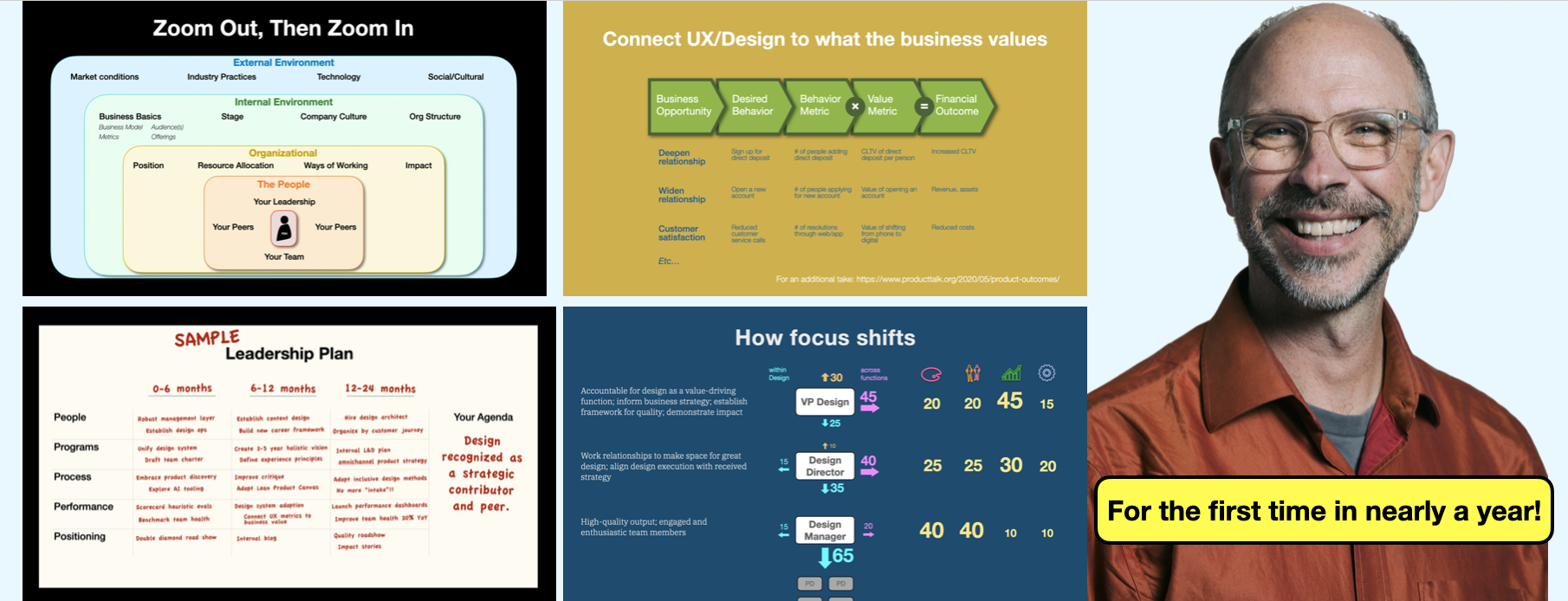
In 4 hours of class time (2 hours each day), you'll learn the mindsets, practices, and tools that successful UX/Design Leaders use to advocate for a human-centered agenda within their organizations. Every attendee receives the complete slide deck, 6 activity templates to scaffold your leadership efforts, all notes from the discussion with other design leaders (anonymized), and additional resources for further study.
Also, I'm bringing back my tiered pricing, recognizing that not everyone has organizational support for their professional development:
- $399 (your employer pays, or reimburses you)
- $309 (you have a job, but you are paying out of pocket)
- $209 (you don't have a job currently)