Strap in. This one gets wonky.
For some personal work, I'm unpacking the question, "What are the conditions that enable a humane organization?" Emerging from that effort is the concept of 'legibility,' and I believe it to be crucial to understanding why UX/Design struggles within so many organizations.
Stop me if you've heard this one
"Design slows us down."
"What's the ROI of design?"
When you're asking for budget: "You want to talk 10 people? We already know what our customer wants."
When you're presenting your findings: "You only talked to 10 people? How is that credible?"
"Can you just make this idea look good?"
UX/Design is often received in an annoyingly reductive fashion. In response, we either try to contort our work to others' expectations, or waste spend a lot of time 'educating' people.
But what's at root here isn't simply a communication challenge—it requires a fundamental understanding of the functions within a business, and the work that gets 'seen.'
Legibility

I'm using the concept of legibility established in the seminal sociopolitical text Seeing Like a State, by James C. Scott. His signature example is (bear with me!) scientific forestry in eighteenth-century Prussia and Saxony, where the state sought timber revenue and so saw the forest only in the metric of "board feet." Anything else (the undergrowth, deadfall, and countless inhabiting species) had no bureaucratic visibility. The state remade the forest to align specifically with that metric: irrelevant species cleared, trees planted in ordered rows. While the first generation grew beautifully, the second collapsed, because those illegible parts had been what kept the forest alive.
Where the forest had "board feet," UX/Design has "screens to be built by engineering." All of the work that ensures that those screens are the best that they can be — qualitative research, sketching, ideation, iteration, structuring, mapping, conceptual modeling — is illegible, and thus invisible to the broader organization.
This is not some fault of design, but instead reflects the values of business operations. Organizations value predictability, so that they can plan, budget, and communicate likely outcomes to their stakeholders. Predictability requires determinacy, where the nature of the work (its processes and outputs) are understood ahead of time—engineering will take 6 weeks to work through these Jira tickets; marketing will spend $50,000 to draw this amount of traffic. Determinacy in turn defines legibility, the qualities of work that can be seen, appreciated, valued, and accounted for.
Much of UX/Design work is indeterminate, and thus illegible. Examples include:
- You explore four concepts and choose one. The three abandoned efforts are invisible, and you're asked why you didn't just start with the workable one.
- Research reveals the requirements were misguided, so you reframe them around actual customer need. The roadmap retains the same name, so it appears nothing has changed.
- You draft the experience principles that will inform hundreds of downstream decisions, but none of which will be traced back to them.
How did it get this way?
There are historic reasons to explain why UX/Design is uniquely illegible. When you consider other functions within a business—engineering, marketing, sales, finance, operations—they evolved in parallel alignment through the gauntlet of business rationalization, becoming part of an MBA curriculum, standardized through measurement, systematized in their practices, and adopting similar languages and concepts of models, pipelines, funnels.
Design was never rationalized in such ways. UX/Design is a highly synthetic practice, drawing on information and communication design's studio tradition, HCI, information science, the social sciences, and human factors engineering. Each has its own hard-won rigor, but because none of them passed through the business rationalization project, these perfectly sound practices are illegible in the corporate context.
The fundamental disconnect
For most business throughout the 20th century, it didn't matter that the work of design was largely indeterminate, because it was mostly performed by agencies and consultancies, special-purpose organizations where indeterminate work was legible.
In the 21st century, as most businesses became, at least in part, software businesses, the bulk of UX/Design work shifted in-house. With rare exception, this integration has been awkward. UX/Design people didn't fully understand that when the business said "we need design," the business didn't mean human-centered problem-framing and problem-solving practices that shape how the business engages its customers. Those practices are indeterminate and thus illegible. The business sought determinate, and thus legible aspects of design: the creation of software screens and, perhaps, conducting usability tests.
This explains why UX/Designers are told that they are "slowing down" the work. This explains why UX/Designers are more frustrated and less satisfied than their peers, why they are the most likely to discourage others from joining their field. This explains why "The ROI of UX" is a fool's errand. This explains why recruiting and hiring practices for UX/Design are broken in most companies, and why corporate career frameworks are clumsy fits. And, ultimately, it explains why we're seeing UX/Design recede in so many companies.
Design Leadership as Legibility Lens
I have long contended that design leadership is more difficult, or at least meaningfully different, than other functional leadership, and I now see legibility is the root cause. Other functions share a rationalist, MBA-honed worldview, and so while their practices may be distinct, their legibility is much higher.
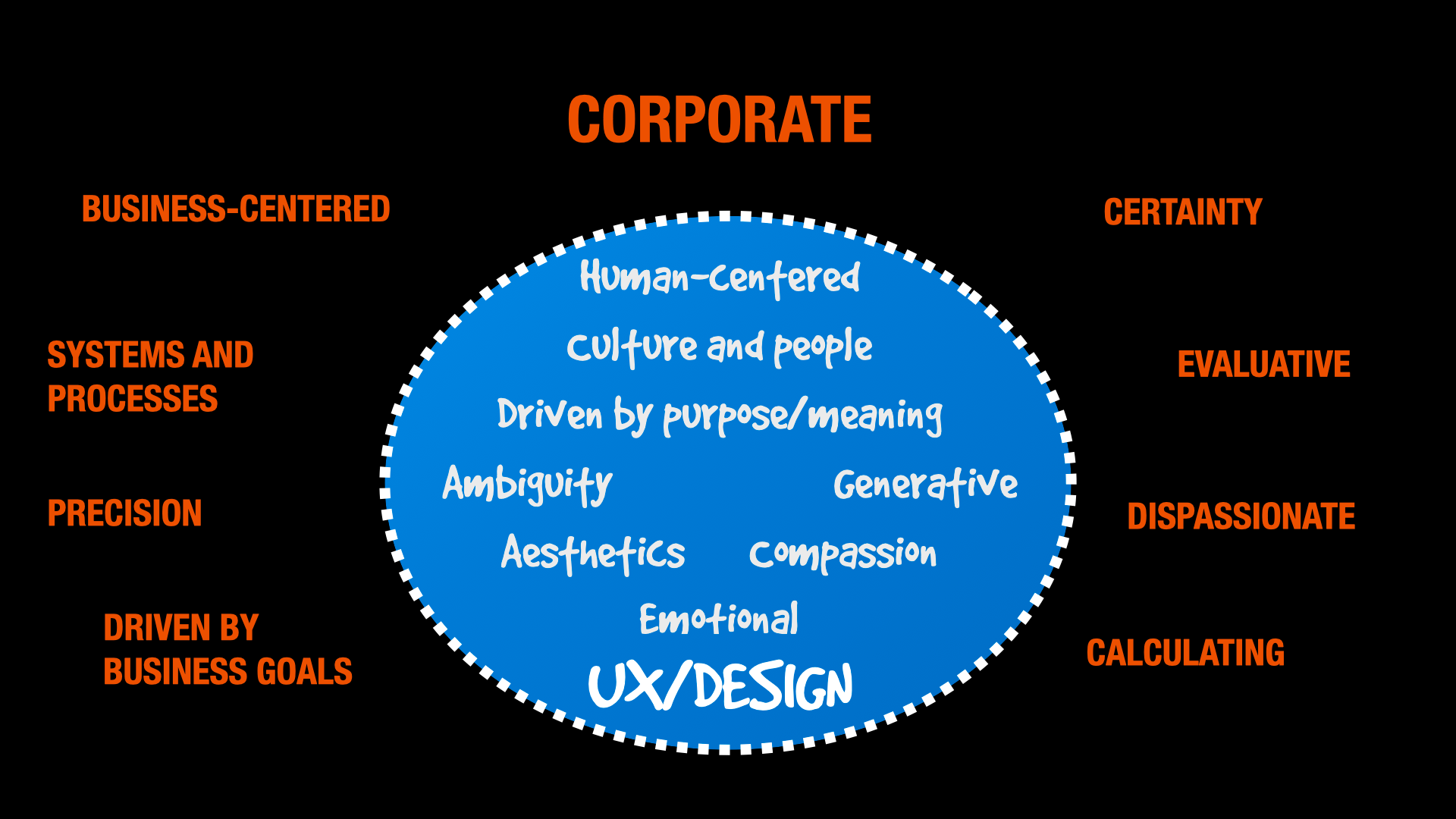
In my Design Leadership Demystified masterclass, I introduce the concept of "mediating the membrane," where design leadership lives at this interface (the dotted line in the image above) between their team and the rest of the organization. Another way to look at this is that design leadership is a legibility lens, making the work of their team legible within the corporate context, while also making the corporate context understandable to their team.
This legibility frame illuminates a potent detail that had escaped me. Where in the past I argued that design leadership is about translation and connection (I have used the phrase "connect design to what the business values" countless times), the real work is subtler and actually much more difficult.
If we want UX/Design to avoid the fate of the forest's second generation, the real work of leadership is to evolve what businesses see as 'legible.' We need them to widen their aperture to appreciate the value of indeterminate work, which is open-ended, exploratory, emotional, meaningful, even beautiful.