Layoffs are top of mind again due to Meta's and Intuit's actions this past week. They are just two of many companies that have recently reduced headcount as part of restructuring in the face of AI, including Block, Oracle, Cloudflare, Atlassian. And doubtless more are coming, for reasons I will soon explain.
When this recent layoff wave began, in late 2022, along with it came commentary from business school professor Jeffrey Pfeffer, who called out this behavior as a "social contagion." Since there's no evidence that layoffs are good for business, these decisions are made because other executives are doing it.
What's become clear these past five years is that much executive behavior is driven not by evidence, but by a "monkey see, monkey do" approach to leadership:
The hiring boom of 2021-22. Companies scaled because they saw other companies scale, and were afraid of being left behind.
Return-to-office (RTO) mandates. While there is some evidence that fully remote work leads to a 10% reduction in productivity, it's not because of anything inherent in remote work, but because companies lack management practices to support it effectively. That same research shows there is no evidence that requiring more than 2 days in the office per week has any productivity gain, and in fact the more days in the office, the less productive, as people lose valuable time to commuting. Yet, executives at ostensibly 'data driven' enterprises like Amazon still demand that people work in an office 5 days a week.
AI mandates. I'm hearing of companies that incentivize token spend per employee. This is like commending engineers for writing more lines of code. It has nothing to do with impact. It's productivity theater. If AI were so amazing, you wouldn't need mandates—people would be clamoring to introduce it into their work (the way they did, say, Slack a decade ago).
The most recent layoffs. The message has been startlingly consistent across companies these past six months: we're "restructuring" due to AI, we need to shift spend to compute, we're reducing layers of management. When executives parrot one another, that reinforces the hypothesis that what's at play is not a deeply considered decision (which would be rooted in the specifics of that company), but social contagion.
How companies grapple with uncertainty
There's a fancy academic name for the mechanism at play here: mimetic isomorphism. This term was coined by org psych academics Paul DiMaggio and Walter Powell in an 1983 paper [PDF, and quite wonky!] that addressed a puzzle: why do organizations become more similar over time, even when similarity doesn't make them more effective?
They identified three mechanisms:
- Coercive isomorphism—when external forces require certain behaviors, such as regulatory requirements, or demands from boards of directors
- Normative isomorphism—as functions become professionalized and standardized, they codify expected behaviors
- Mimetic isomorphism—in times of uncertainty, organizations copy what it appears the more successful companies are doing
My focus is on the latter, because if anything has been true since the pandemic, it's that we're in a time of heightened uncertainty. And it's specifically the response to this uncertainty that triggers the more egregious corporate responses.
But, this raises the further question—if mimetic isomorphism isn't effective (layoffs are not good for business; RTO mandates are explicitly unproductive; companies are spending heaps on AI without seeing any concomitant gain), why does it persist?
The anthropologist in me believes that it is just deeply human. Copying others is the most common way we learn. When we're in a situation we don't know what to make of, we look around, see who seems to have figured it out, and do what they're doing. This works perfectly well in stable contexts, where true experts are recognized and their lessons are worth following.
In uncertain times, the wiser move would be to let the uncertainty play out, maybe try some small things, but mostly just observe and be ready to act as things clarify. But that looks like inaction, and executives can't NOT act—they must do SOMETHING.
Nnot knowing what to do, feeling pressure to move quickly, they copy what it appears that others are doing. But, by the very nature of this uncertainty, those others don't really know what they're doing either. The uninformed copy the foolhardy. It's not a recipe for success.
And even when some companies have done the work and their decisions prove effective — that doesn't mean it makes sense for the copiers. Mimetic behavior is a "how" without a "why" — engaging in observed processes and rituals without understanding the specific context that produced the outcome.
As countless broken "agile" transformations have shown, process divorced from context does not deliver desired results.
The power of mimetic isomorphism is that when the desired outcomes aren't achieved, folks rarely criticize the process itself—they assume that it hadn't been followed correctly. But it's more likely that the process simply doesn't suit the organization. I think of the Spotify squad model, and how you had thousands of companies that were not Swedish music streaming startups adopt that approach, and then wonder why it didn't seem to work.
How the contagion spreads
Mimetic isomorphism occurs at every level of an organization. But there's something different about broad mandates and maneuvers when they emerge from the C-suite. The mechanism of contagion isn't simply observation and imitation. Instead—layoffs, RTO mandates, AI restructuring—these behaviors are reinforced by social networks they inhabit. Group chats, executive gatherings, and other forums are superspreader spaces for these undercooked ideas.
One thing we are collectively realizing is that CEOs listen to one another way more than they listen to their own teams. The people most affected by these maneuvers, who often have the clearest view of what would actually help, have no voice in the decision. A CEO is more likely to trust someone who is seen as a peer, even in a totally different context, than someone who understands how the organization actually operates.
Boards are another vector, though their influence is less visible. What appears as a C-suite mandate may in some cases have originated with the board, which would make it coercive isomorphism rather than mimetic. But the contagion still operates: board members are connected with one another, and are a vector for information spread. And we still have mandates divorced from outcomes.
An additional source of contagion are management and IT consultancies, who bring the ideas to laggard industries where an imprimatur is required for such change. The consultancies are institutionalizers of these ideas, whipping up methodologies, presentation decks, white papers, and complicated spreadsheets that provide organizational cover for decisions already made on vibes. This has been evident in the spread of hacky "Agile" transformations run by firms who've never built product themselves, but have an extensive SAFe-style framework they are only more than happy to impose on otherwise clueless enterprises (I'm looking at you, BCG).
When authority is divorced from accountability
DiMaggio and Powell point out something important: even though copying in times of uncertainty is irrational (given that it generally doesn't work), every individual can rationalize their own decision-making: "It worked for them, so I thought it would work for us."
The burden of consequences does not fall on the decision makers. It falls on team members who were never consulted. People who understood the organization's context, had evidence to offer, but were not in the room. Instead, those with the ultimate authority sought counsel from peers in wildly different contexts, and then hamhandedly applied those approaches without any tailoring or translation.
Executives can get away with it because though they have authority, very rarely are they held accountable (one of the perks of being in charge!). Their boards are supposed to hold them accountable, but as we shared, the boards get information through similar means, and would likely have made the same call.
We're all just primates here
That this paper is over 40 years old, and we're seeing these patterns are not only still in play, but likely magnified due to increased connectivity, suggests an uncomfortable reality: there's not much that can be done about mimetic isomorphism. It's deeply rooted in both human and organizational behavior.
What I do hope is that understanding the mechanism at play sheds meaningful light on how companies actually operate. As we come up within on organization, we are lead to believe that the business is making rational decisions—rooted in data, analytics, and reasoned comparisons. And in an effort to participate, we do what we think is the work: research, analysis, quantification. We make rational cases for our positions.
Sometimes that works. But it's not how many decisions are made, and it may be not how any of the most important decisions get made. Many of those decisions are rooted in core primate behavior — copying perceived leaders, ignoring contradicting evidence, following conventional wisdom because deviation is costly.
Don't beat yourself up when your reasoned argument doesn't land. Recognize that your leadership may just be bringing an irrational frame, and likely made the decision before you ever entered the room.
Let's collaborate to navigate this insanity
Design leaders have it particularly tough during these intense and chaotic times. I work with many heads of design across industries, org sizes, and geographies, helping them be their most effective regardless of the circumstances.
My primary offering is the coaching-like Thought Partnership, and I also consult and provide fractional support. If we should talk, don't hesitate to reach out.
Are you in Scandinavia, the Baltics, or Warsaw?
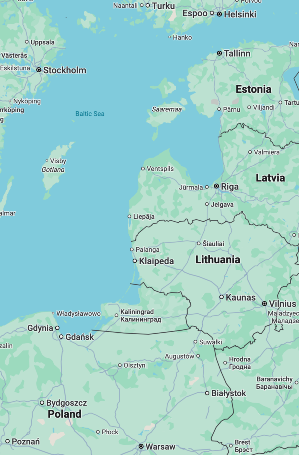
I'm traveling with family for much of June, and would be happy to meet up with locals in Stockholm, Helsinki, Tallinn, Riga, Vilnius, and Warsaw. If this is you, please reply and let me know.