![[TMA] You Can't Yell It Away: The Courage Design Leaders Need Now](https://storage.ghost.io/c/ca/c9/cac97c1b-e5da-46f3-8732-c6daebdd23b2/content/images/size/w30/format/avif/2026/05/courage.jpg)
It's understandable to be wary, anxious, frustrated, fed up with, or just over the imposition of AI within your work context. As Paul Ford shares in the just-published episode of Finding Our Way: (Apple Podcasts, Spotify, website with complete transcript):
This is the worst [technology] rollout in history... It shows up out of nowhere. The leaders of the companies... have many qualities, but they're not great communicators about what's coming. They don't know the capabilities of their own platforms. And it comes on a level of hype that is essentially trying to match Bitcoin hype, but with a weird database that talks to you.
All of which has been exacerbated by arbitrary executive mandates and layoffs justified as "AI restructuring" — compounding FOMO, exhaustion, and burnout.
Thing is, as Paul also says:
[Y]ou're not gonna put it back in the box. You can't yell it away.
Even noted AI skeptic Erika Hall has acknowledged, "I have become somewhat resigned to the likelihood that the trend of organizations using computer in the stupidest and most wasteful way possible just has to flush through the system until the costs catch up to the hype."
In my leadership masterclass, I used to quote the serenity prayer, and this is a time where it feels apropos: "Grant me the serenity to accept the things I cannot change, the courage to change the things I can, and the wisdom to know the difference." UX/Design leaders cannot change the technology. So aim your courage at what you can change: your organization's response to it.
Embrace the tooling, build the expertise, get out in front
I'm interviewing design executives to better understand how they're handling this intense and chaotic moment, and one of them shared with me:
Design is actually leading where Product could be leading... I think there were more people in the Product organization that were behind on AI adoption than in the Design organization. So we... did their job for them, because they were more bystanders than using it to drive strategy themselves. That has helped design be very upstream at the moment, and take a lot of leading roles.
This echoes Jesse's mantra: "Whoever controls the prompt controls the product." The courage here is for leaders to create space for their teams to develop this aptitude, which likely involves pausing or slowing down work. Thankfully, even amid the broader insanity, many higher-ups recognize this to be a trade-off worth making.
Focus on skills and teams, not roles
This is one of those things that leaders can do... but it will likely piss a lot of people off.
I wrote about this at length 2 months ago, and each passing day affirms it further—anchoring on roles is the wrong unit of analysis. In this vein, a different executive I spoke with is considering labeling all on his team as "experience designers," regardless of specific skill sets, for two reasons: explicitly broaden their mandate (attending to the entire end-to-end experience, not just the 'product'), and free themselves of role-specific constraints.
While this kind of organizational change is very much under a leader's control, it requires greater courage, marshaled behind persistence, to overcome forces which preference the role mindset, specifically: a) bureaucratic practices that don't see people as individuals, but as roles in a system, and b) the deep identity affiliation people have with their roles.
Don't 'set direction'; create the conditions
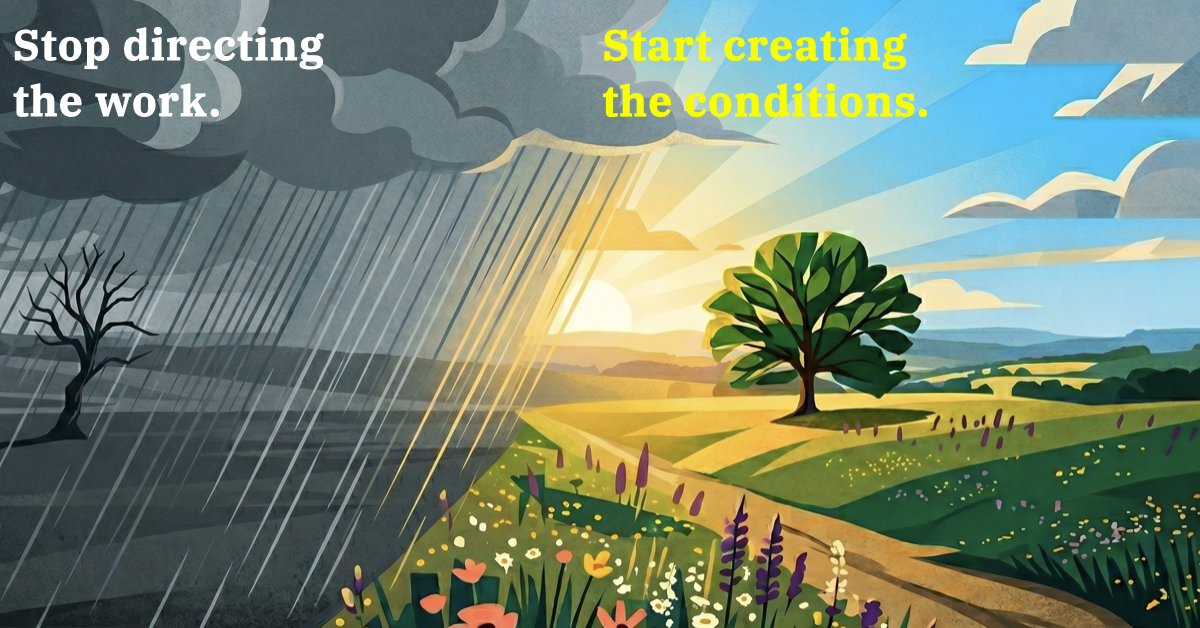
With the arbitrariness and uncertainty of this terrible technology rollout, design leadership can't afford to be prescriptive. Top-down direction breeds brittleness.
Instead, leaders need to create an environment of fluidity and responsiveness, but with a clear sense of orientation and purpose, so as to ride the chaos without getting caught up in it.
The courage needed here is to not let the insanity of the moment become your crazy. With everything in flux, a natural reaction is to get more detail-oriented to prevent anything bad from happening. But with acceleration, there's an explosion of details, and managing them directly will quickly exhaust you.
Instead, successful design leaders are shifting their perspective from "setting direction" to "creating conditions." Operating at the level of conditions—clarity of outcomes, expectations for quality, fundamentals of practice, cultivating trusting relationships—is achievable, and more likely to sustainably lead to desired results.
It may take a few revs to get things moving in the right direction, so additional courage is needed to stay the course.
The responsibility is the job
Leadership is also a choice. In moments like this one, the choice carries weight: if you're going to occupy the role, you owe your team and your organization what this moment actually requires — not what you signed up for when things were calmer.
Design leadership has always required intention and discernment. This moment adds a third requirement: the courage to create the conditions for your team to do its best work. This means choosing a direction before the path is clear, making calls your team won't all agree with, and accepting that you'll likely get it wrong before you get it right.
Make no mistake: this moment is a leadership crucible. And stepping aside is a legitimate option. But holding on without putting in the work to make positive change is not.
AI Transformation for Digital Design Teams
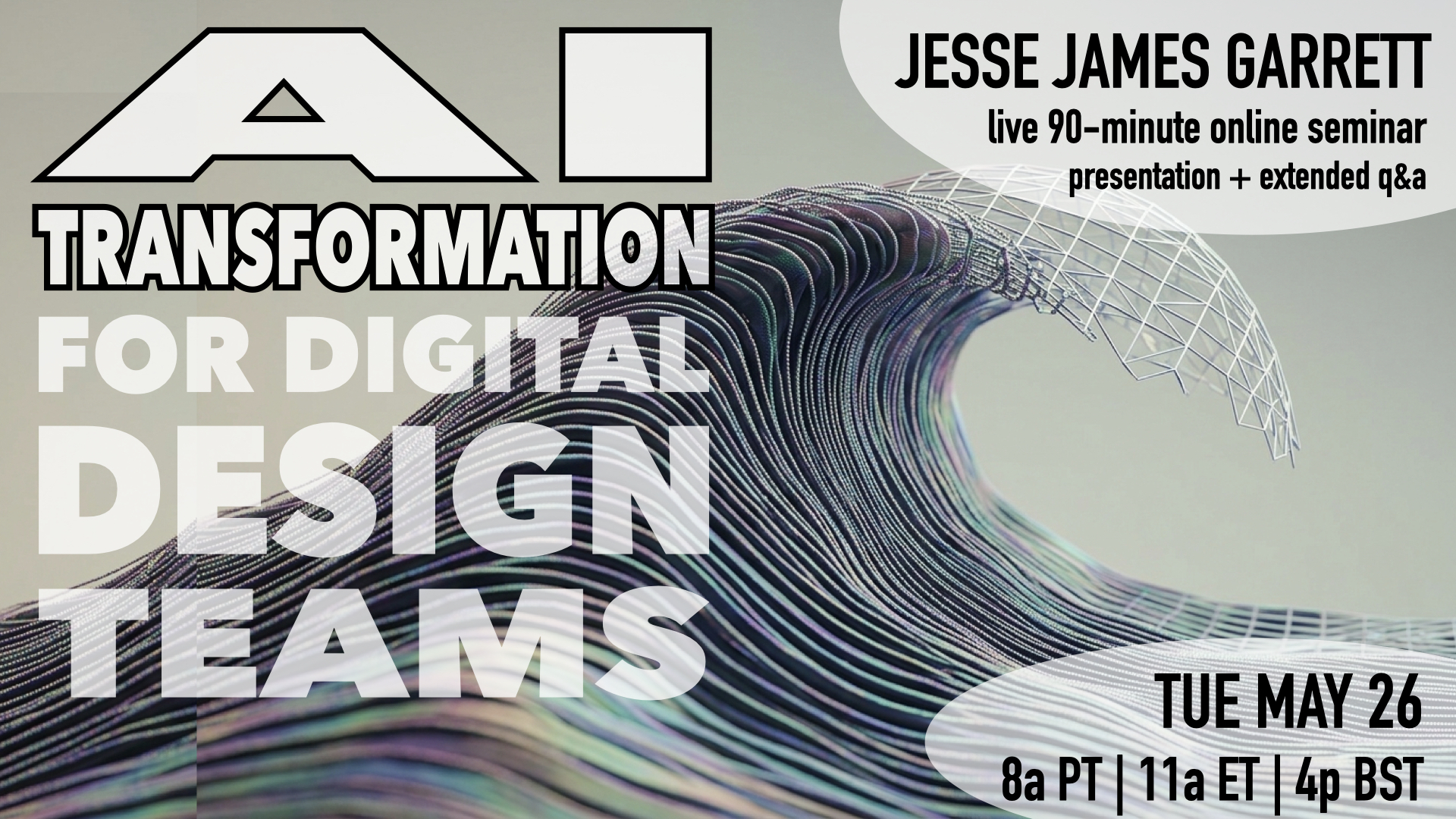
My pal and podcast co-host Jesse James Garrett will lead a live seminar on AI Transformation for Digital Design Teams on May 26th. In it, he lays out a series of concrete steps design teams can take to get out ahead of this moment, to ride the wave instead of having it crash on you. And he's offering The Merholz Agenda readers a 36% discount—use code PETERME and pay only $25 (full price $39).