(Stick around to the end for more information on my forthcoming masterclass, including discount for newsletter subscribers.)
There exists a paradox in the application of AI in UX/Design in that the highest leverage activity is perhaps the least discussed. Let me explain.
In a survey of tech company designers, the average number of AI tools in use more than doubled from three in 2025 to seven in 2026.
I learned this last Wednesday at the Design Futures Assembly (DFA), a room featuring people operating at the leading edge—heads of design from Anthropic, OpenAI, Google, Expedia, demonstrations of tools including MagicPath, Dessn, Pencil.
Now, I think a LOT about the context in which design is practiced. And this data point shined a bright light on the general sense of overwhelm and anxiety that designers are facing. Pre-AI tooling, most designers were already overtaxed, spread thin across too many workstreams, attending superfluous meetings that could have been emails, compensating for product managers who don't know how to lead discovery or effective prioritization. All of which constrained their practice, inhibited quality, and drove frustration and burnout. Remember this from Lenny's survey last year:
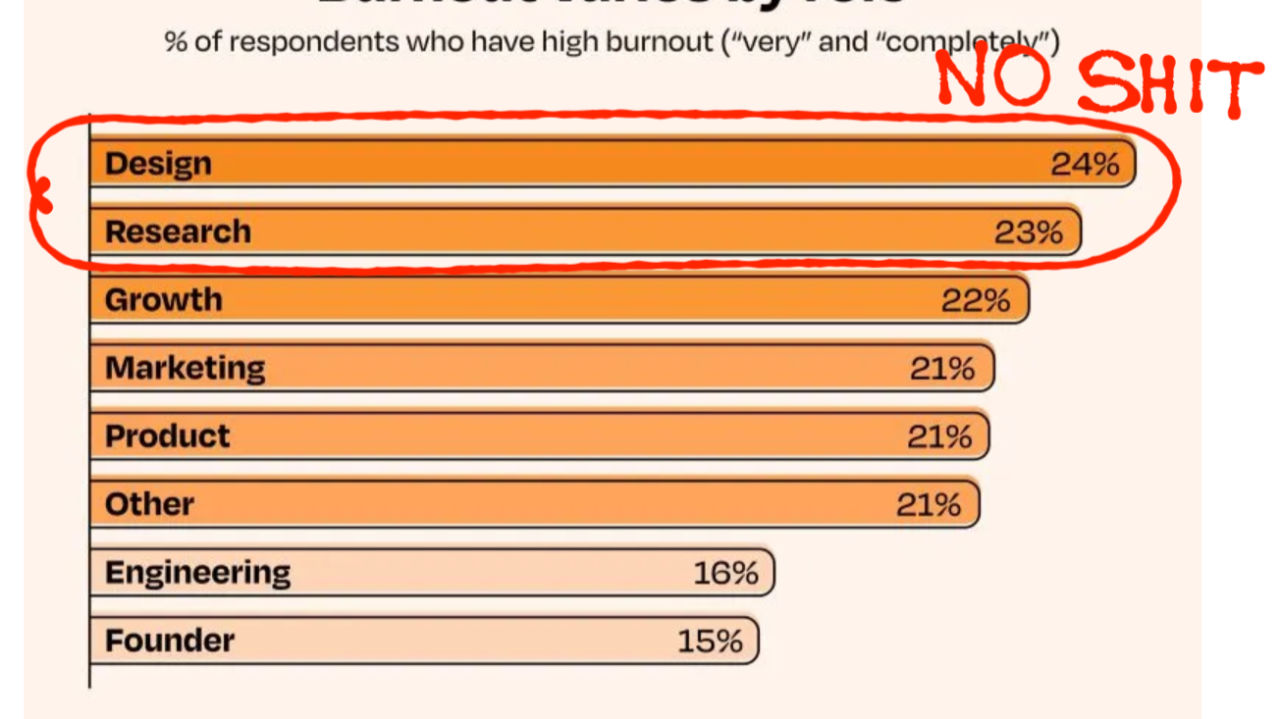
So, we've taken an already frazzled professional community, and dialed up the intensity with an expectation that they'll master a doubling array of AI tooling on top of everything else.
At the DFA, a related discussion was around a company's "go-to stack," the tooling used for product development. And research shows: there is none. Just in that room were representatives of Figma, Adobe, Lovable, Pencil, Dessn, MagicPath, Anthropic, OpenAI, and Microsoft, and you can add Cursor, v0, Bolt, Magic Patterns, and doubtless others.
The proliferation isn't the problem. A Cambrian explosion of tools is what you'd expect at this stage. The problem is that team members are provided no guidance, no structure, no framework for navigating the options, and each person feels like they have to figure it out for themselves. Which then creates additional chaos because these tools aren't used in isolation—they must connect with a product development workflow and its various stakeholders. Every individual's improvisation creates downstream cost for everyone else.
There's an uncomplicated solve that too many companies overlook.
This is a problem for Design Operations.
It's 2026, and I still hear of far too many scaled design organizations—20 people or more—that lack DesignOps. Some never had it. Frustratingly, many did, but Ops was often a casualty as teams have been encouraged to 'do more with less,' and design leaders failed to articulate the value it delivered. Because Ops folks don't deliver directly, they were considered nonessential.
This is a gross misreading of the value of Ops, and AI has made it expensive now.
Ops is about enablement. It's about "the work about the work." It exists to keep practitioners focused on the content of the work, handing off communication, coordination, process management, tool management, and other aspects that would otherwise eat up their week.
When you have 20 or more folks, Ops is the way to do more with less.
And AI-enabled product development creates the most chaos in the exact realms Ops owns: tooling and ways of working. It makes no sense for each designer to cobble together their own tech stack and invent their own workflow. Ops organizes the piloting of tools, distribute what works across teams, retire what doesn't, and propagate the learning when one team hits on something that clicks. That's leverage. That's how a practitioner gets to maintain focus on what's most important to them: the work itself.
Leaders that cut or neglected DesignOps in the name of doing more with less are now watching their teams do less, worse, with more chaos and greater anxiety. The work about the work never went away, it's just being done haphazardly, in the margins of every designer's day.
Ops is the function whose job was to absorb exactly this kind of shock. Without it, you've decided your designers' time isn't worth protecting.
Design Leadership Demystified masterclass, May 19+20, with discount code
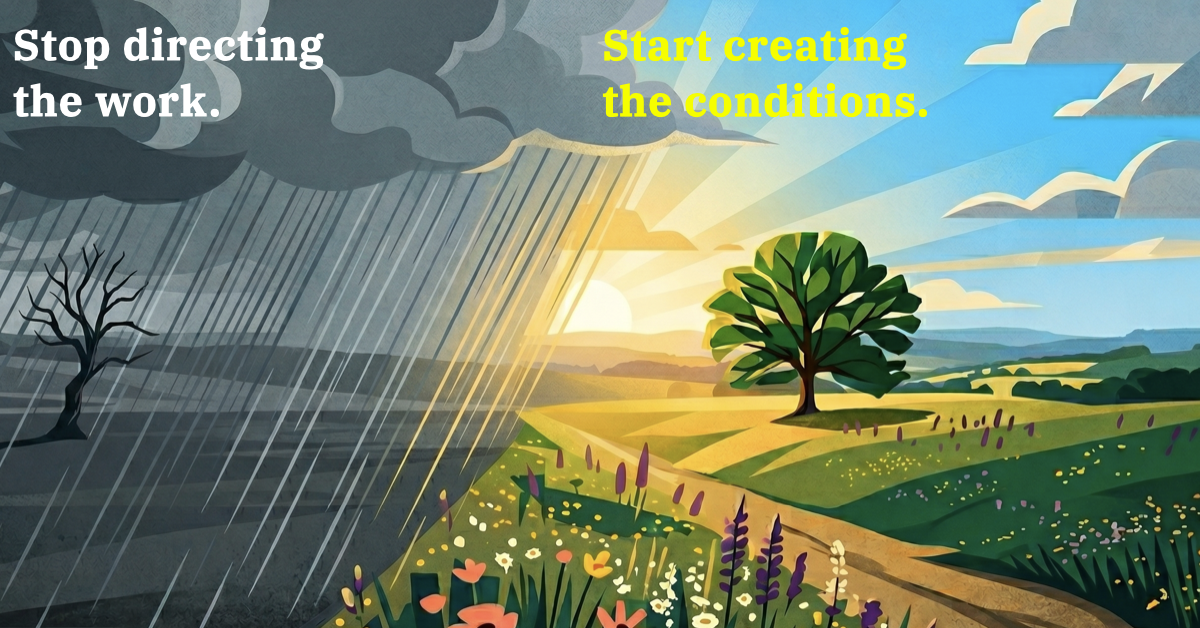
My leadership philosophy has long focused on establishing context for people to do their best work. And in chaotic moment, design leadership cannot afford to be prescriptive. A team running on top-down direction gets brittle exactly when it needs to be adaptive.
Leaders need to create an environment of fluidity and responsiveness, but with a clear sense of orientation and purpose — a way to ride the chaos without getting caught up in it.
This is what I address in Design Leadership Demystified, my forthcoming masterclass (May 19+20, 1pm-3pm PT/4pm-6pm ET) on the behaviors that create the conditions under which good work becomes possible:
- clarity around desired outcomes
- expectations for quality
- space for human-centered practices
- cross-functional relationships that keep design's voice in the broader conversation
- roles aligned to responsibilities
None of this is new to design leadership. But in it's way of stressing what is already there, AI is making it even more important to practice these fundamentals.
Price: Employer pays: $399 | Self-funded: $309 | Between jobs: $209.
Newsletter subscribers can use code AGENDA10 to receive 10% off any Self-funded ticket.