![[TMA] Fundamentals and the Future: Leadership Edition](/content/images/size/w30/format/avif/2026/03/Gemini_Generated_Image_7gyyhr7gyyhr7gyy.png)
The most recent Finding Our Way is titled "Fundamentals and The Future," (Apple Podcasts, Spotify, website with complete transcript) referring to guest Dan Saffer's take "that there's really only two things right now that are worth teaching: One is the fundamentals, and one is the stuff that's on the cutting edge." He identifies design fundamentals like typography, aesthetics, behavior, making meaning. With the cutting edge being getting a handle on all this new intelligence-informed tooling.
Dan teaches design practice, with a focus on craft. But I'm seeing how the same dichotomy applies to leadership, with even greater stakes.
I recently spoke with a design leader who is actively employing AI tools to advance his company's operations. He used Microsoft Copilot to analyze customer service issues in hours what used to take a full team weeks. He built an internal interactive customer journey portal with Figma Make, surfacing insights that had heretofore been ignored. His design team now has access to GitHub with the promise of committing their own changes. He's the person explaining MCP tools to engineers who don't yet understand the basics.
But with all this evident progress, he feels stuck.
He shared how the vast majority of his 250-person digital org is resistant to let go of business-as-usual. Executives talk about customer-centricity, but what is prioritized demonstrates otherwise: tech debt, screen-level fixation, and top-down roadmap execution. So while others see and appreciate this leader's efforts, they just keep doing what they were doing. He suspects that their perception of him as a design leader means he lacks the organizational stature to make substantive change.
Across LinkedIn and similar spaces, the discussion right now is that AI fluency is the path to relevance. Experiment with the tools, show capability, solve real problems, and the organization will follow. But this situation shows that capability without organizational pull just leads to frustration.
What this leader realized is that AI savvy alone doesn't get it done. As Saffer's dichotomy implies, the future needs to be balanced by the fundamentals. For design leaders the "fundamentals" aren't typography and behavior. They are cultivating trusting relationships, advancing a clear agenda, and rolling up his sleeves to engage in the day-to-day work of managing change. This needs to develop his leadership capability alongside his use of AI to drive the kind of transformation he envisions.
I've got a cohort for that
When I started my discussion with this design leader, I didn't expect that their situation would prove to be a case study for why Jesse and I are launching The Intentional Design Leadership Circle. Even though that landing page doesn't talk much about AI, this conversation validated why this cohort is so important right now.
Our current AI Moment™ doesn't obviate leadership fundamentals—it necessitates doubling down on them. Uncertainty breeds opportunity. But to take advantage of the opportunity, you can't just be adept with the new tools, you need a reservoir of foundational leadership practice to draw upon.
Updates on Design Quality
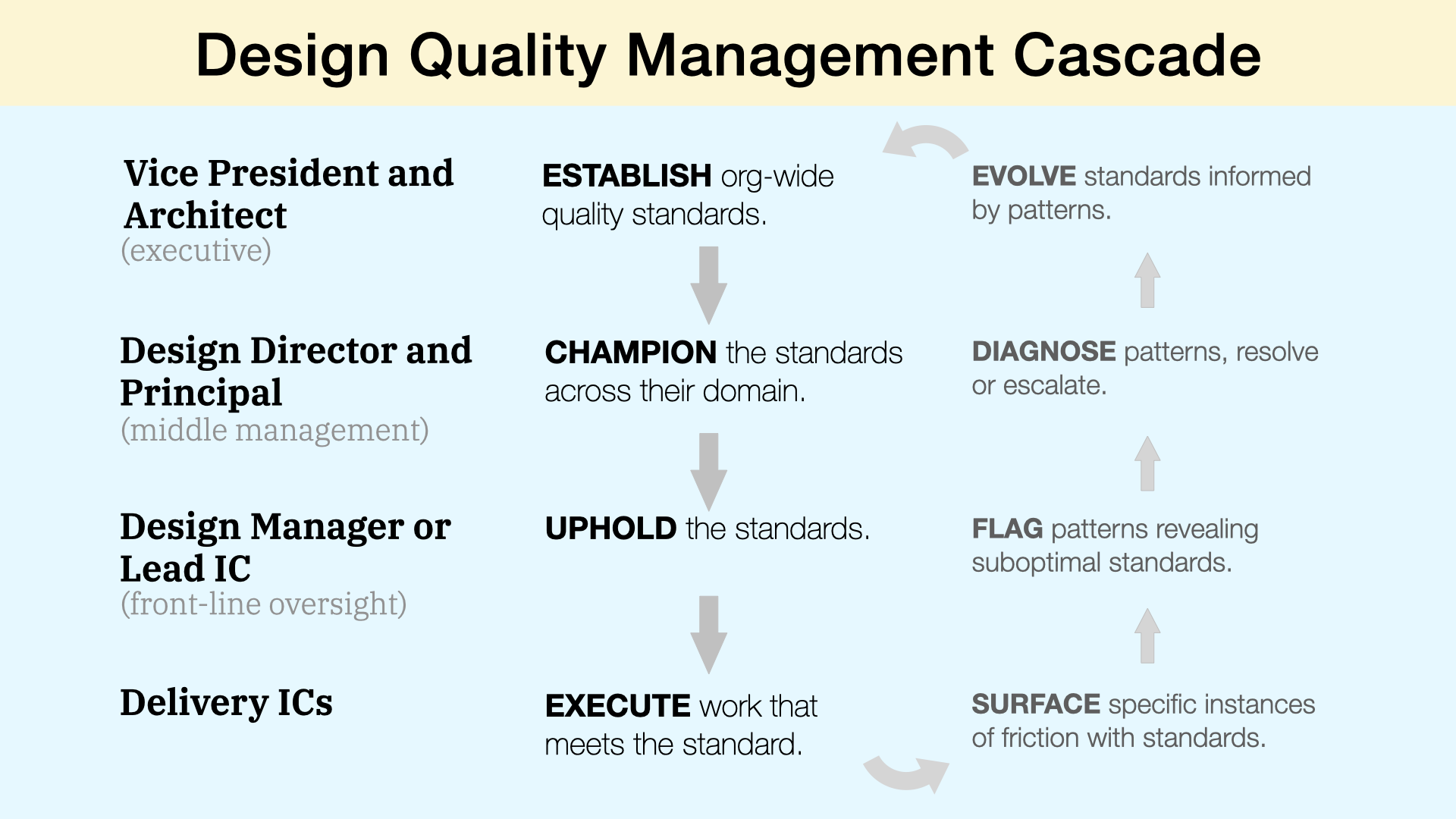
Last week I wrote about how this existential moment for design requires a renewed focus on clarifying quality. This spurred additions to Design Org Dimensions, my subscription-supported digital 'book', specifically the creation of a "People" section in the Dimension 4: Quality.
As I expanded my thinking, I significantly reworked last week's Design Management Quality Cascade, incorporating Delivery ICs, and better distinguishing responsibilities across levels. A teaser:
I deeply appreciate your support so I feel comfortable carving out the time to write in my attempt to meet this AI Moment™.