Quality is Everyone's Job — Just Not the Same Job
[Published 22 March 2026]
In my work with design executives, a common dysfunction I witness is leaders operating at the wrong level. VPs directing the work of individual contributors. Directors running critique sessions their managers should own. The head of design as the organization's primary — sometimes only — quality enforcer.
The problem is structural. When responsibilities for quality are poorly defined, they don't distribute themselves evenly, they float upward. Senior leaders fill the vacuum because they care, because they have the judgment, because they're ultimately accountable, and because no one else has been clearly charged with the work. Executives now can't fulfill their actual mandate because they're doing other peoples' jobs. Managers and leads who have been bypassed, believe their judgment isn't trusted.
In larger design organizations (50 and above), there's a second, related problem. Even when design leaders want to provide creative and strategic quality leadership, they often don't have the bandwidth. A VP is consumed by executive and managerial responsibilities. A Design Director overseeing 15–20 people, managing hiring, professional development, and cross-functional relationships, has little capacity for creative leadership. That sustained attention that quality requires—what good looks like, deep engagement with craft, developing and maintaining quality frameworks—doesn't get done. No one consciously deprioritized it, but the more urgent aspects of their role meant that no one was structurally positioned to do it.
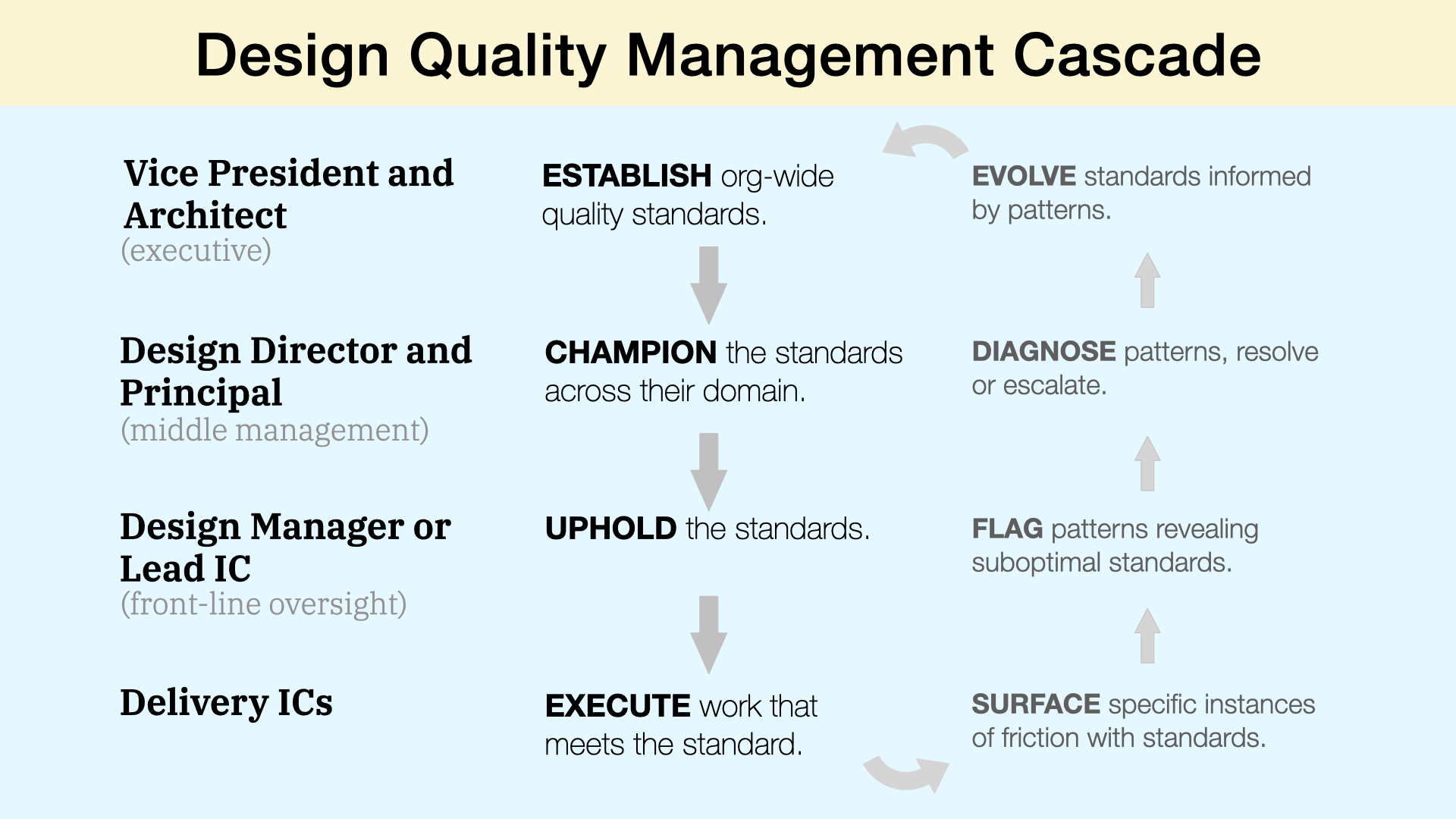
Every person in a design organization has a relationship with quality. What differs is the nature of that relationship — what each level is responsible for, and what that responsibility actually looks like in practice. Getting this right allows quality to be genuinely owned throughout the organization rather than concentrated at the top (and then neglected, ignored, underappreciated, abandoned, untethered everywhere else).