Before we get into the newsletter...
Starting in one week!

Design leaders: If you'd like to take your career into your own hands and learn new ways to thrive, join Jesse and I in the autumn cohort of the Intentional Design Leadership Circle. Up to 20 Director-level design and UX leaders participate through six weekly sessions that track a standard leadership journey. The Circle provides space and time to reflect on your work, connect with others in similar situations, and project the future you want to become.
It's a fantastic way to use your learning-and-development budget. And if you don't have an L&D budget, we offer a special rate for people who pay their own way.
Newsletter subscribers use code PETER10 to receive 10% off the ticket price.
Learn more and register.
To Lead is to Sell
Last week I facilitated my first-ever Leaders Salon at Shift UX. 25 leaders, split across six tables, gathered in a room in Brooklyn to think about how to position UX, design, and themselves for a shifting reality.
What surprised me, from the outset, was how many people talked about sales. They worked in sales-driven companies, their job was to help salespeople close deals, and one even declared, "We are all going to be salespeople."
About the only thing UX and design leaders dislike more than "playing politics" is "sales." It feels unseemly. We believe the quality of the work should speak for itself. We're not here to pretty up an interface to close a deal; we're here to deliver human-centered value that goes much deeper than the surface.
But these leaders showed me that many UX leaders operate in sales-led environments. If they want to have impact, they need to understand and collaborate with colleagues whose grasp of design is often only surface-deep, which is exactly why design needs to show up.
As Jesse James Garrett said to me during a break, "If Sales is driving the company, then it is better to have Design in the room with them than not."
Make Friends with Sales
Later in the Salon, when we were identifying specific tactics to better situate UX within the organization, one of the most popular was "Make Friends with Sales."
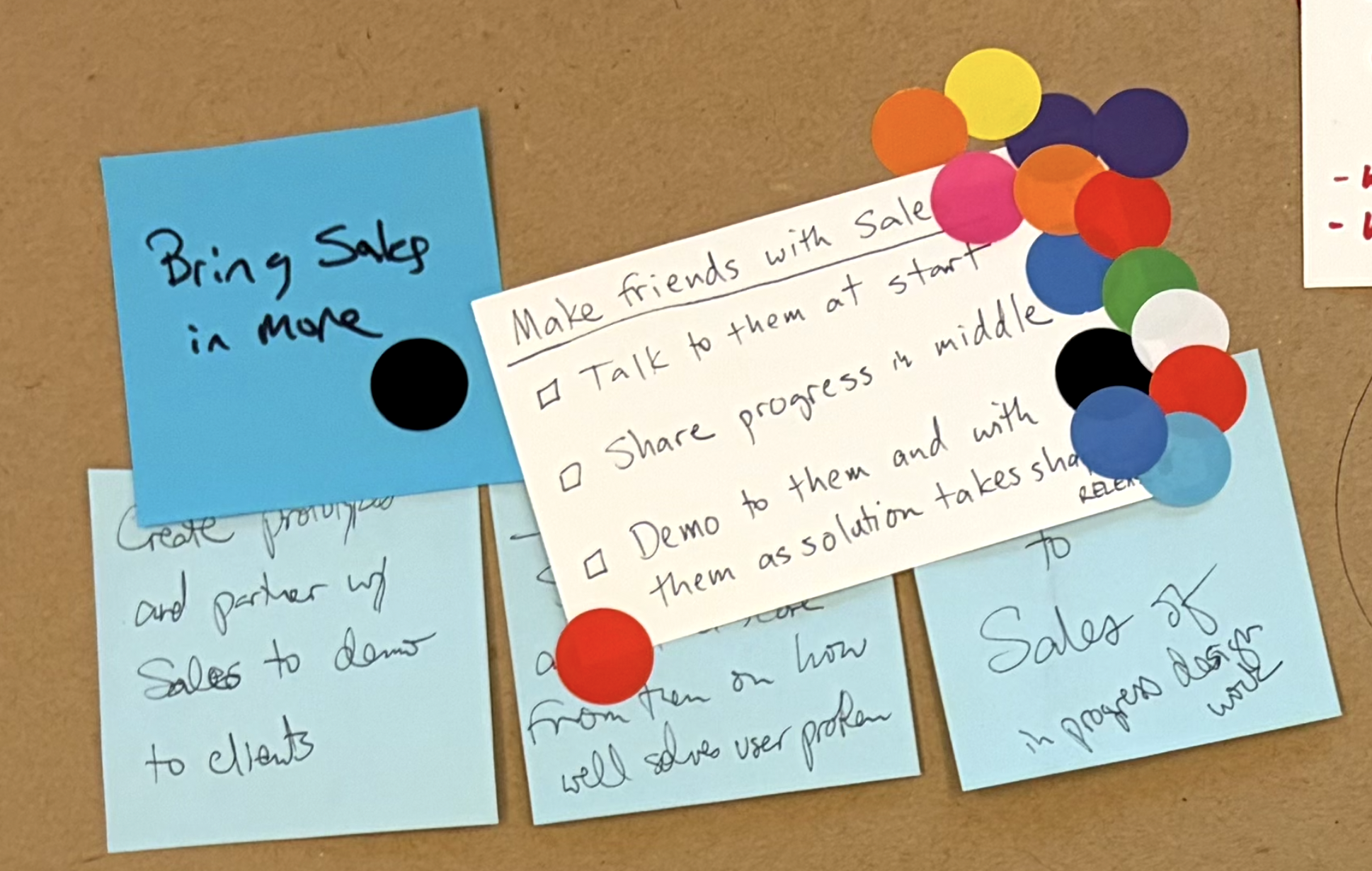
When I shared this on LinkedIn, a bunch of folks basically said, "Well, duh." The comments are thoughtful and illuminating. They reinforce that for people in enterprise SaaS and other B2B settings, this has always been part of the job. A couple stand out. Seth Johnson shared:
"When my team started bringing user-centered approaches to IBM’s massive sales organizations, we were pleasantly surprised to learn that most (great) salespeople are natural design thinkers. Empathetic, focused on understanding their client’s problems, wanting to meet their needs, deep listeners, direct line to the support org, etc..."
Gustavo Silva goes further:
I spent 10 years in sales before moving into design, and what surprised me going the other way is how much research Sales is already sitting on. They hear the customer's real objections every week and nobody writes them down as findings.
The other half of it: Sales doesn't want design to make things pretty (ok, sometimes they do), they want something they can demonstrate. When my team started building working prototypes instead of slides, those prototypes ended up in deals we were never in the room for. That did more for design's standing internally than any amount of explaining what UX is.
You need to "Sell" your organization
A different tactic came in response to the prompt "How might we secure UX's standing?" As one table put it:
"It looks like you are running your own small business within your org. You create materials to 'sell' your team, do cold calls/introductions, figure out 'customer' sentiment/pain points and build relationships."
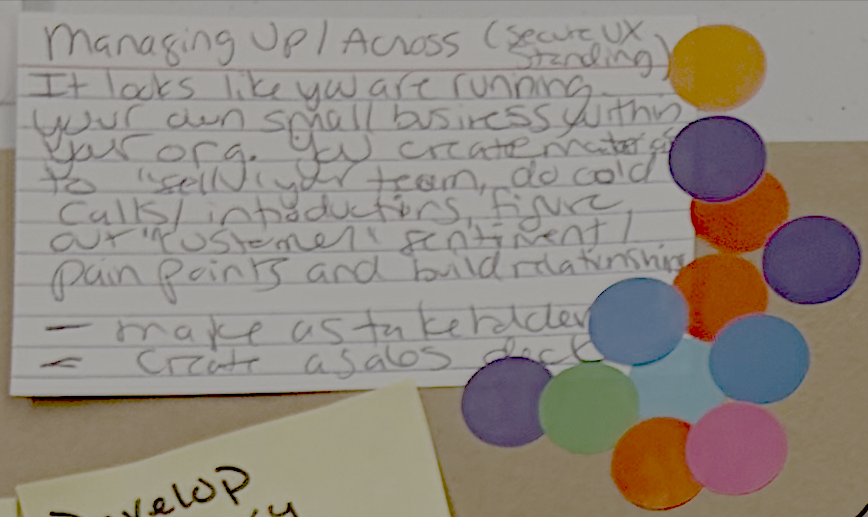
I appreciate this framing. As an org designer, I think about how UX/Design is a function of the firm, and as such, compares and contrasts with other functions, particularly when hustling for resources. Approaching it as a small business sharpens this take, making it clear you're not here to just do craft, but to have sustainable impact.