In 2014, at Adaptive Path's UX Week conference, I presented my definition of the profession of a UX Designer. Using Dan Saffer's diagram as a launchpoint...
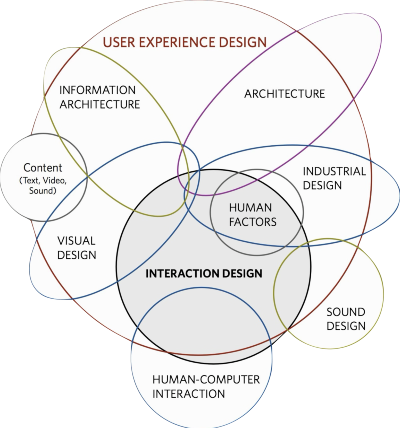
...I stated that UX Design wasn't some 'super practice' that incorporated all of these disciplines. Those disciplines are those disciplines, with their own practices, methods, bodies of knowledge, etc.
I argued that, instead, we should think of UX Design as "what's left" (the white parts in the image, and the circle surrounding it)...
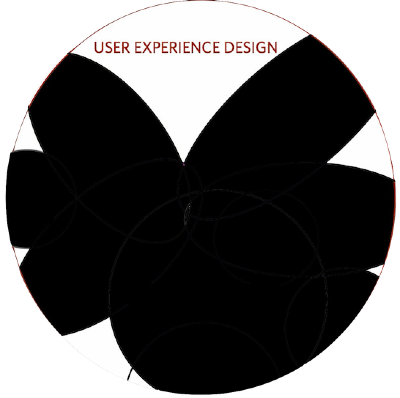
...that UX Design is the harness that holds these disciplines together toward a common objective.
So what's the work of a UX Designer? Reflecting on our practice at Adaptive Path, I identified a UX Designer's activities as: generating user insights, making business cases for design, facilitating cross-functional ideation and solutioning, generating concepts, articulating an experience strategy and vision, planning roadmaps of phased experience delivery, and providing ongoing orchestration and oversight throughout its creation.
And I remember Christina Wodtke in the audience raised her hand, and asked, "Isn't that product management?"
At this time, I had been out of Adaptive Path and in-house in Silicon Valley for a few years, worked with dozens of Product Managers, and had never seen any of them do these things. They were so focused on wrangling engineers, hitting ship dates, and tracking business metrics, that they neglected, or didn't even really recognize, this kind of work. So I said, "Not that I've seen."
This story came to mind a couple weeks ago in conversation with Jesse James Garrett, as part of our Intentional Design Leadership Circle (winter cohort to be announced soon!). He stated that, "The days of the head-down designer at their desk with their headphones on cranking out drawings is gone. The designers who thrive on your teams going forward are the ones who are best at the cross-functional communication and negotiation that is required to create alignment." He followed this with, "When you've got 'shoot out at the prototype corral,' where I bring my prototype, you bring your prototype, and we’ll see which one wins, you’ve got to be able to articulate the drivers behind those decisions."
And then it came to mind again this past week as I thought about Lenny's "2026 State of the Job Tech Market," which shows that product managers are doing well, engineers are plateauing, and design and research are falling behind.
It came to mind because, as I have written before, the UX/Design profession has kind of done this to itself. As my presentation showed, over a decade ago, there was an opportunity to cast design as a crucial component of product and service development, to bring human-centered practices into strategy and planning, to demonstrate the value of bringing an end-to-end experience perspective to a company's increasingly complex offerings.
Instead, in reframing the work as "product design," we over-indexed on visual interface design, we allowed (even encouraged!) individual designers to be embedded in "agile" teams, we shifted much of our focus to building design systems, and we wouldn't shut up about "craft."
Meanwhile, following the lead of people like Marty Cagan, Teresa Torres, and Melissa Perri, product management incorporated practices like "product discovery," talking to customers, planning, iterating, and connecting their work to business value. [Though, many product managers still do NOT do this work, instead just shipping what they're told in the feature factory. But that's a whole other thing.]
So we fucked around, and now we're finding out. By limiting our impact, and thus our value, we should not be surprised that we're falling behind. Nor should we be surprised that product management, after incorporating UX practices, appears to be gaining.
So, What To Do?
I write this as I head to Toronto for the annual Design Leadership Summit, the theme of which is "Design's Unfinished Business." I look forward to discussion of the opportunity for designers to re-embrace an expansive mandate and to deliver a kind of value unique to our practice.
Before the main program, I'm facilitating a workshop, where I will challenge participants to address a set of imperatives. The first imperative is "Stake Your Claim," which starts with this context:
AI enables anyone to generate a prototype. PMs produce slop PRDs. Engineering has spec-to-build pipelines.
Your company is deciding what design is for, and the default answer is often "screens," (which, of course, is the part that AI does best.)
Demonstrating value inside that default only entrenches it.
How might you re-frame Design’s value?
Then I offer these provocations for the participants to work through, and which you may want to consider yourself:
- If everyone can prototype, who does what?
- AI is making design output cheap and plentiful. What becomes scarce instead?
- What new value could we be delivering?
- What will your team stop doing, and which requests will you decline?
- What do your designers need to be good at now that you didn't hire for?
- If you were building the team from scratch today, what would it look like?
As Jesse said when we discussed AI transformation on Finding Our Way, “The opportunity is not just to do what you're already doing better. The opportunity is to take a step back and look at what design is and means for an organization.”
For the past decade or so, when we fucked around, we lacked intent. We reacted to others instead of putting forth our vision of an actualized practice, allowing ourselves to be defined by the artifacts of our execution, not the impact we could make.
It's time to fuck around again, but now with purpose. What might we find out?
How about some Thought Partnership?
I don't really have anything specific to promote, but I always have my coaching-like practice of Thought Partnership, where I collaborate with heads of design as they work through their most difficult challenges. In this way, I've supported leaders around the world, from startups to massive enterprises, on subjects ranging from org design, establishing quality standards, recruiting top talent, thorny management issues, communicating value to executives, and more.
If you'd like to learn more, contact me and we'll find a time to talk. Or maybe you know someone who could benefit from such support?