Well before the AI Onslaught, businesses realized they needed to address the confusion and overwhelm of their complicated offerings. One client of mine in enterprise SaaS memorably referred to his company's "rubble pile", products and features largely assembled through acquisition with little to no integration. Or consider services like banking and health care, that struggle to coordinate across multiple products (checking, loans, brokerage), touchpoints (web, mobile, phone, chatbot), and internal tools.
These onerous workflows leave users unsure where to turn to start some process, complete that process, and often have to input the same information two, three, even four times across different platforms. Each piece of the workflow may be well designed, and delivering on their specific metrics. But when strung together, businesses see issues such as abandonment, increased call center volume, lower satisfaction scores, and decreased engagement.
Businesses are realizing that their standard go-to's are not delivering. In January, I wrote about how product management's failure is UX/design's opportunity. The short version: executives are witnessing the shortcoming of a portfolio of uncoordinated offerings that confuse customers, exhibit needless redundancies, and cost a fortune to operate. They turn to product management leadership, but those folks struggle to address this, as, throughout their careers, PMs were rewarded for shipping their thing, on time, with blinkered concern for only their metrics. This 'vertical' mindset inhibits their ability to operate holistically.
So there exists an actual business problem that the C-suite now acknowledges, but no function has stepped up to address it.
What a function owns
I have written about how when you approach Design as a function, instead of a practice or craft, you better understand its struggles within most organizations.
Established functions are defined not only by their activities, but also the decision rights they own to something that the business considers important.
Finance owns capital allocation. Legal owns risk. Marketing owns demand. Sales owns revenue. Engineering owns reliability.
What UX/Design typically owns feels like small potatoes—consistency, usability, accessibility. None of which addresses meaningful business value at scale.
I think we've been selling ourselves short.
An argument can be made that Design owns coherence—how a suite of offerings, across channels of delivery, adds up for the person on the other end.
Coherence leans into what Design is already good at—practices that put people at the center, observing behaviors, architecting systems, and crafting interfaces that better enable them to succeed. Whereas product management is 'vertical,' design inclines to the 'horizontal,' anchoring on the user's journey and their end-to-end experience.
Going far beyond UI design, coherence incorporates:
- brand — personality, characteristics, identity, that "thing" that makes umpteen products recognizable as one company
- rich insights — actual observation of what people are actually trying to do, and how it crosses boundaries
- service design — coordinating backstage and front-of-house, across channels, ensuring seams are acknowledged and appropriately handled
- content design and information architecture — beyond surface consistency to deliver clarity and comprehension throughout a complicated experience
Increasing legibility
Those of us in Design know how crucial each of these elements is, and how the user experience suffers when any of them are given short shrift. We've struggled to articulate a clean value proposition for those who are not already bought in, falling back to a superficial notion of 'consistency' and 'ease-of-use.' Much of what we value is not legible to the business.
This is why I'm bullish on coherence. When I interview executives stakeholders at client companies, I hear their frustration with multi-product and multi-channel offerings confusing their customers.
In 2016, McKinsey wrote an extensive series titled Customer Experience: creating value through transforming customer journeys. Of particular interest is this graphic which focuses on a cross-channel experience:
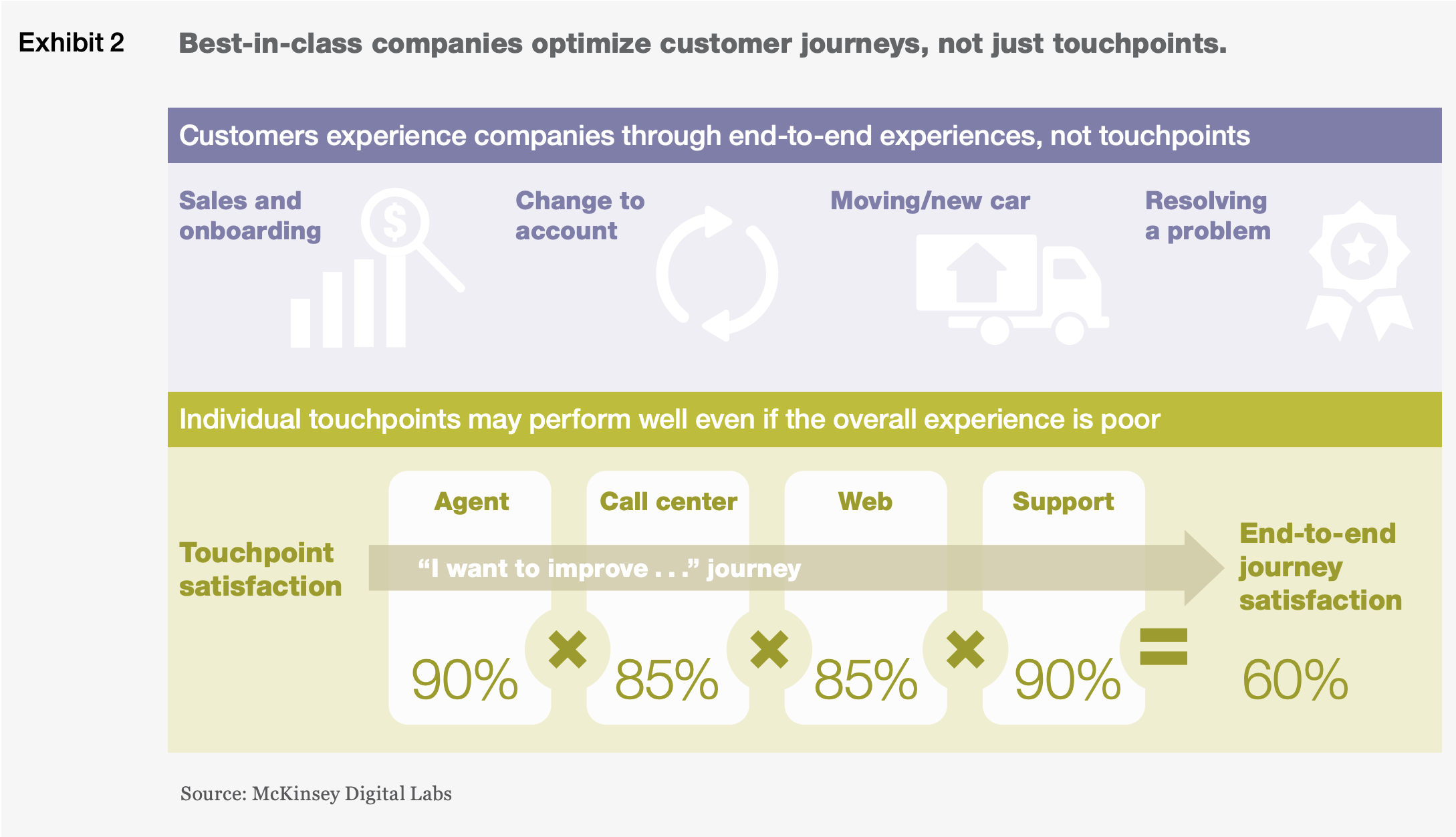
They present a case study about a media company that was trying to address customer churn through improved customer experience. They thought they were doing great, because each touchpoint scored highly, but:
Most customers weren’t fed up with any one phone call, field visit, or other individual service interaction—in fact, most customers didn’t much care about those singular touchpoint events. What was driving them out the door was something the company wasn’t examining or managing—the customers’ cumulative experience across multiple touchpoints, multiple channels, and over time.
As the diagram points out, a journey with four touchpoints scoring 90%, 85%, 85%, and 90% delivers a 60% end-to-end experience. Piece parts that earn a grade of A or B turn into a whole that receives a grade of D.
This makes a business case for coherence.
Considering how much McKinsey was investing in Design at the time (they acquired industrial design company Lunar the year before), it's curious that the function of Design is not mentioned as a way to address the coherence challenge. "Design" appears only as a verb and a phase of a project.
Instead, the only roles associated with this work are a chief customer officer and cross-functional journey owners. And while these may be helpful (if anyone can actually define what a chief customer officer is), this approach comes up short because it over-relies on governance, and totally ignores that there are functions whose capabilities can address this. Basically, they wrote a definition for the function of Design but neglected to name it. It's no wonder that, a decade later, all the governance in the world has made little impact on those end-to-end experiences.
The work: making clear that this is a Design problem
We "know" that driving coherence is something that Design is particularly equipped for. But how do we articulate it? I don't have the answers, but I think I have a framework for the approach:
The decision moment. Finance can stop spend. HR determines job offers. Engineering says when something is ready to ship. Coherence lacks any specific moment—it's the sum of a series of decisions. What decision does design make that drives coherence?
The evidence. Legibility is often (though not always) the result of some metric (in the original example from Seeing Like A State, the Black Forest was reduced to lumber in board feet). The metrics that indicate coherence are owned by others or have too many possible causes. The contact center tracks first contact resolution, transfer rate, and repeat contacts. Friction metrics like Customer Effort Score and time-on-task may be the purview of a single team. Abandonment rate may be due to an overcomplicated cross-boundary flow... or it may just be because shipping costs too much (or whatever).
Now, not every bit of ownership requires metrics. Legal owns risk, and there aren't really metrics against that. And metrics don't guarantee ownership—HR is accountable for employee engagement, but that score is driven more by executive behaviors.
So, how do we make coherence evident?
The capabilities. Other functions (customer service, operations, product management) may stake ownership... So why Design? I'm wary of turf wars, but I also believe that coherence benefits from a humanistic approach distinctly lacking in those other disciplines.
How have you advocated for coherence in your organizations?
Please share in the comments.
Intentional Design Leadership Circle

Last spring, 20 design leaders joined Jesse James Garrett and me on a journey over six weeks of discovery, connection, and betterment. One participant shared:
The Intentional Design Leadership Circle combined thoughtful leadership theory with candid dialogue among experienced peers. It gave me the rare feeling of being genuinely seen and understood.
So we're bringing back the Intentional Design Leadership Circle for an autumn cohort, starting October 7, and available remotely (with US and European friendly times). We offer early bird discounts through September 25 (my birthday!). Learn more and register.
Shift UX VIP Leaders Salon
This is something I'm excited for, as I've never done anything quite like it, but I think it has real potential for helping (re-)frame UX/Design leadership within the enterprise.
On September 23, I'm facilitating the VIP Leaders Salon at Shift UX, taking place in New York City. Participants spend the day reflecting, connecting, and engaging in activities to understand how your can better navigate this intense moment. If you're interested in the Salon, but not the rest of the event, we have just made it available as a standalone: enter code "salon-shift26" on the registration page.
The Salon page shows the entire agenda, with all that you can expect to get out of the experience. It promises to be worthwhile.